
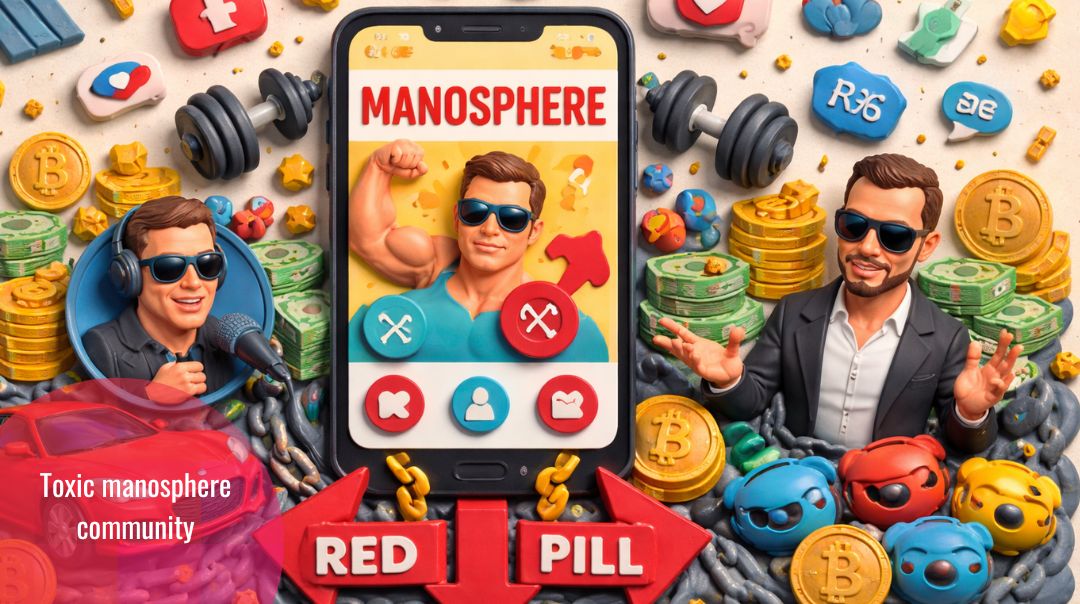
The Internet has created entire parallel worlds of ideas, identities, and ideologies over the past decade. One such world is the so-called manosphere – a loose network of online communities, blogs, forums, and influencers who share the belief that men are systemically disadvantaged in modern society. Although sometimes presented as a space for “male self-help”, the manosphere is often intertwined with pseudoscience, misogyny, and radical political ideas.
The Manosphere is a community that promotes what they describe as “traditional” masculinity – where men have the dominant role in a relationship and women are subordinate. Recently, the documentary Louis Theroux: Inside The Manosphere is available on Netflix, which is definitely worth watching as a kind of quick review, a digest of the manosphere so that you don't have to go into those profiles and watch a series of videos to see what it's all about. Although Theroux does not show the devastating impact of the manosphere on women and how it encourages femicide, but only shows who these people are, and is rather superficial, without reflection and analysis, the documentary is worth watching. It will make someone want to vomit, and someone will see it as a comedy.
The term manosphere appeared in the early 2000s and today encompasses various subgroups: “men's rights” activists (MRAs), so-called “pickup artists”, the looksmaxxing sect, the incel community (involuntary celibates – men who believe they are condemned to sexual isolation), and the popular “red pill” movement. These communities share a narrative that feminism has supposedly destroyed the “natural order” of relationships between men and women. In that story, men are presented as victims of the system, while women are presented as manipulative or privileged.
This story is also spread through gyms, the sale of supplements and advice for gyms and through the self-proclaimed community of alpha-males in endurance sports, especially triathlon and Ironman, where a pseudo-stoic pseudo-philosophy is especially promoted (a man must endure pain, show no emotions, be disciplined and focused). By the way, men are victims of the system, but not of feminism, but of patriarchy and late neoliberal capitalism, in which they and their work are seen as a fairly cheap commodity – including manual labor.
I recently watched a reel in which a man explains that there are many beautiful women, but few successful men, and that successful men are actually a reward for a woman (I guess if she is good and obedient), and not a woman a reward for a man. The problem is that viewing oneself as a reward for someone is completely wrong, degrading and is actually under the influence of capitalism – in both cases it is about objectifying oneself and reducing it to one value – appearance or success, while no one defines what success is for whom. It's nothing more than selling yourself as some kind of production value. Instead of being human and enjoying the fleeting beauty of being human and living life, movements like this turn us into commodities.
Much of the influence of the manosphere today comes from internet influencers. Among the most famous are former kickboxer and entrepreneur Andrew Tate, as well as podcast host Joe Rogan, whose content often serves as an entry point into wider manosphere narratives. Tate, who became globally famous thanks to viral clips on social media, promotes an extremely hierarchical view of gender relations, where dominance and financial power are key indicators of “male worth”. Developing boys become victims of this trend that pushes them into right-wing movements, radicalizes them. And they become victims of imposed supplements, especially anabolics, which change their mood, make them aggressive and make their body stop producing natural testosterone.
The problem arises when such ideas begin to be presented as scientifically based. The manosphere often uses simplified or misinterpreted concepts from evolutionary psychology and biology to justify social attitudes. For example, it is a popular claim that women are “biologically programmed” to choose only a small number of the most dominant men, while the rest are condemned to marginalization. These ideas are often based on the misunderstood theories of sexual selection that originate from the works of Charles Darwin, but some influencers turn them into deterministic and ideological claims that are not supported by science, that actually have nothing to do with Darwin's theory of evolution. Which implies, in this case, that success is mining and selling supplements and bitcoins. Many women find these self-proclaimed alpha men with their jaws and muscles repulsive.
Pseudoscientific elements in the manosphere can be recognized by typical patterns: selective citation of research, use of anecdotes instead of data, and creation of simple “biological laws” that purport to explain complex social phenomena. In this way, social frustrations – such as loneliness, economic insecurity or changes in gender roles – are turned into supposed scientific facts.
At the same time, researchers of digital culture note that the manosphere often represents an entry point into broader radical political communities. Studies by organizations like the Institute for Strategic Dialogue show that social network algorithms can gradually steer users who consume manosphere content toward more extreme political narratives. These narratives often include conspiracy theories about the “failure of the West,” anti-immigrant rhetoric, or open support for authoritarian political ideologies. This rhetoric often begins with a story of male stoicism, focus, and discipline, and ends up on the right-wing, fascist, and misogynist sides of the political spectrum.
They also advocate conservative non-monogamy (or unilateral monogamy), and in these circles men compete to collect as many “dots”, trophies – women, who are viewed exclusively as objects. In these groups, men share pictures of women, show intimate pictures and videos to each other, with the aim of humiliating women, thus creating AI nude pictures of women and uploading such pictures and videos to forums and closed groups. Let us remind you that according to the new Criminal Code in our country, these are criminal acts. In addition, there is a trend in that community to downplay the tragedy of rape and the drugging of women and rape. Rape is glorified, and the victims are ridiculed. The live broadcast of femicide is the final result of that snuff trend.
Some of the most extreme cases also showed the violent potential of these ideas. The attacker of the Isla Vista killings, Elliot Rodger, left a manifesto in which he openly described the beliefs typical of the incel community. While the vast majority of people who watch manosphere content will never commit violence, events like this show how digital subcultures can radicalize individuals who already feel marginalized.
Influencers from the manosphere (man influencers), such as Jordan Peterson and Justin Waller, sometimes present themselves as “gentlemen”, and the only thing that makes the connection between them and gentlemen is their suits. People who sell their advice to the youth, self-proclaimed educators and mentors of guys have always existed in society. But there were also those who are young men who are just forming and learning to conquer girls, to be independent, taught to be polite. A suit does not make a man, and neither does a man, and especially not the oxymoronic concept of “unilateral monogamy” that some of them advocate, in other words, that he cheats and tricks around, fakes illnesses that he passes on, she changes their children's diapers and is only with him. Loyalty is an expensive gift and should not be expected from cheap people. I mean, the manosphere, manfluencers, and all that retrograde product that reeks of a puffed-up teenager, of immaturity, of lack of emotional and social intelligence, of empathy, of hormones and testosterone-filled sweat and lack of personal hygiene, that mothers, girlfriends, and teachers have to endure, is very cheap. No, I don't think teenagers are cheap – just those who sell them this bland pill.
It is important to emphasize that the real problems of men – such as mental health, higher suicide rates, the impact of late-stage capitalism on men or the social pressure to suppress emotions – exist and deserve serious social attention. However, the manosphere rarely offers constructive solutions to these problems. Instead, she often uses them as a starting point for a narrative that shifts the blame to women, feminism, or the supposed “degeneration of society.”
This is why the manosphere can be seen as an example of how pseudoscience works in the digital age. Scientific terms are used as a rhetorical ornament that gives the appearance of rationality to ideologies that are essentially political and identity-based. When biology or psychology are simplified to the level of slogans, jokes, they cease to be science and become a tool for confirming pre-formed beliefs.
At a time when scientific information is increasingly spread through social networks, understanding such phenomena becomes crucial. Not to censor discussions of gender relations or social change, but to clearly distinguish between research, interpretation, and ideology disguised as science.
This is another in a series of texts about the negative and destructive influence of the manosphere on men, women, society and democracy.
The cover image was created using the GAI tool.