
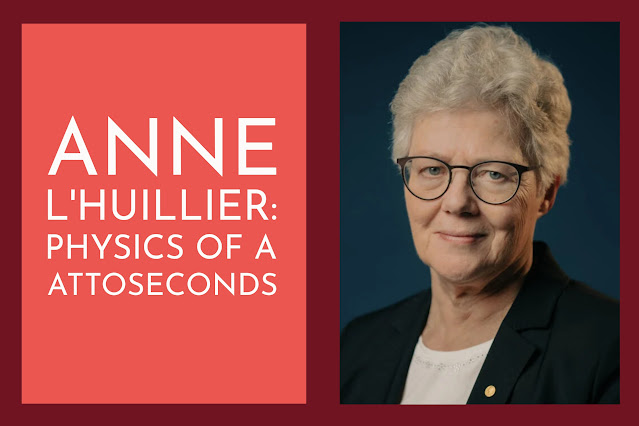
Anne L'Huillier is a French-Swedish physicist recognized as one of the pioneers of ultrafast physics on the attosecond scale. In 2023, she received the Nobel Prize in Physics, which she shared with Pierre Agostini and Ferenc Krausz for their contributions to the study of attosecond pulses. She thus became the fifth woman in history to receive this prestigious distinction and the second French woman to obtain this prize, after Marie Curie more than a century later.
Before her, only four women had been awarded a Nobel Prize in Physics: Marie Curie (1903), Maria Goeppert-Mayer (1963), Donna Strickland (2018), and Andrea Ghez (2020). This distinction highlights the rarity of women honored in this discipline and sheds light on the importance of Anne L'Huillier's contribution to modern physics.
A Vocation Present Since Childhood
From her earliest years, Anne L'Huillier was attracted to mathematics and physics. She drew her inspiration from her grandfather, Lucien Chrétien, an engineer and teacher specializing in radio electricity, but also from Neil Armstrong, whose first step on the Moon would mark her forever. Although those around her imagined her becoming an astronaut, Anne L'Huillier always stated that she wanted to put the power of science at the service of humanity.
During her schooling, her vocation persisted, so she naturally chose to pursue scientific studies.
Eight years later, in 1977, she entered the École Normale Supérieure of Fontenay-aux-Roses at only 19 years old. There, she pursued studies in mathematics and physics before discovering research in 1980. Passionate about the study of interactions between lasers and matter, she then began a doctorate in physics at Pierre and Marie Curie University. After several years of research, she defended her thesis in 1986 and joined the French Alternative Energies and Atomic Energy Commission (CEA) as a researcher.
Her Quest: Observing the Invisible
It was only one year later, in 1987, that Anne L'Huillier made a decisive contribution to the first observation of high-order harmonics. From that moment on, she sought to answer a central question in her career: “How can we create light pulses short enough to observe electrons in motion in real time?”
She then discovered that by focusing a very intense infrared laser into a gas of atoms, it could produce many new light frequencies that were extremely short, on the order of a few hundred attoseconds*. Thanks to these ultrafast pulses, it became possible to track the movement of electrons on the atomic scale.
This scientific breakthrough constituted a true revolution for physics. By generating these pulses of a few attoseconds, researchers could now follow the movement of electrons instantaneously, even before the nuclei moved. This phenomenon therefore made it possible to better understand the movement of electric charges or the beginning of chemical reactions, but also ionization*, for example.
Her discoveries and contributions were recognized in 2011 when she received the L'Oréal–UNESCO For Women in Science International Award. This prize rewarded her achievements in physics but also her commitment to supporting women in science.
Twelve years later, in 2023, all of her research was crowned with the Nobel Prize in Physics for this major breakthrough that profoundly transformed modern physics. This Prize therefore symbolizes the major importance of Professor L'Huillier's discoveries and makes her one of the great figures of science.
*An attosecond corresponds to one quintillionth of a second (10⁻¹⁸ s).
*Ionization is the process by which an initially neutral atom or molecule gains or loses one or more electrons.
Professor and Committed Scientist
Alongside her scientific discoveries, she has trained many students in Sweden at Lund University. Indeed, since 1995, Anne L'Huillier has taught as a professor of atomic physics. Her students describe her as a passionate and curious scientist.
As the second French woman to receive the Nobel Prize in Physics, she places particular value on women in science and encourages them to dare to pursue a scientific career despite the male dominance in this field.
Alix de Carbonierres, a student at the CIFS French School in Sarajevo, she spent an internship volunteering at the Society “Science and the World”.