Many parents today come across long lists of “facts” about vaccines. And it's no wonder that in this sea of information there is fear — because children's health is the most sensitive place of every parent. That's exactly why it's worth stopping, taking a deep breath and looking at each claim calmly, without panic and without labels.
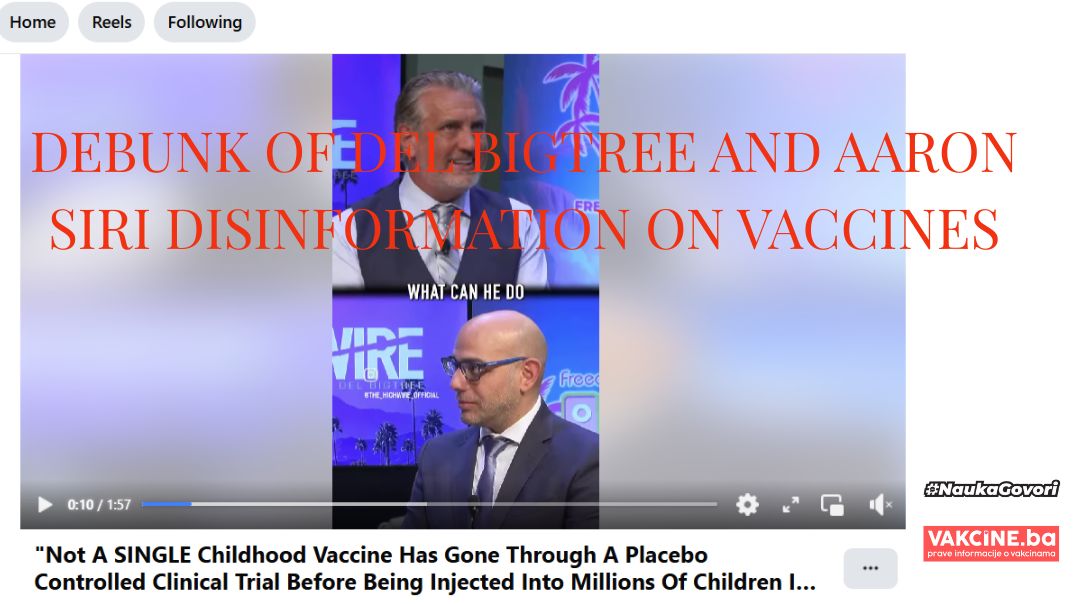
We have received a short video with a lawyer close to RFK, Aaron Siri, whose claims we have already analyzed and criticized, in which some theses are put forward that scare parents, and that is their goal – to scare parents so that as few children as possible are protected by vaccines. The video manipulates, misrepresents data or even presents non-existent data. People mentioned as relevant in the text of the video in Aaron Siri and Del Bigtree. The latter made millions by spreading the anti-health propaganda against vaccines. Del Bigtree & Aaron Siri are not scientists, they use data selectively, ignore overwhelming counter-evidence, and are financially and ideologically motivated. This is a video – reel on Instagram and FB and circulating on the internet that originated from The Highwire podcast hosted by Del Bigtree, a well-known disseminator of vaccine misinformation who has profited from it.
There is publicly available data showing that Del Bigtree and the organization run by the Informed Consent Action Network (ICAN) generate significant financial income, including personal income for Bigtree, which means he can profit financially from the anti-vaccine narratives he spreads. Since its inception in 2016, ICAN has grown revenues significantly over time. In 2019, it had about 3.5 million USD, while in 2022 the amount grew to about 13.4 million USD, and in 2023 even about 23 million USD. These figures show that the organization earns money from donations, grants and other sources, which allows it to fund legal actions, content production and campaigns. Bigtree receives a salary from ICAN. The source for this information is ProPublica.
Authority is not built by noise, but by repeatable evidence.
These are the things in the video that we would criticize and analyze. This video is a classic “Gish gallop”: a long list of claims that sound technical and plausible, but are methodologically flawed, selective, or inaccurate. We will go point by point.
#1 Falsehood: “NO childhood vaccine has ever passed a placebo-controlled trial”
One of the most common messages being spread is that “no childhood vaccine has ever been tested against a real placebo”. However, this is not true. In medicine, placebo does not always mean saline solution. There are different, ethically accepted methods of control: an inert placebo, an already existing vaccine or individual vaccine components. When there is already protection against a serious disease, it is unethical to leave children without it just for the sake of an experiment. That is why new vaccines are often compared with those that have already been proven safe. So, when you say placebo-controlled studies, that placebo can be something other than saline (that's water with a certain amount of salt, 0.9% NaCl).
Why is saline often NOT used as a placebo?
- It is unethical to withhold existing protection against a deadly disease
- The goal is to see if the new vaccine has more side effects than the one already approved
- If the new vaccine is equally safe or safer → it is considered acceptable
- This does NOT “mask” side effects, but enables a realistic comparison.
#2 Falsehood: “Hepatitis B vaccine tested for only 5 days on 147 children”
The example of hepatitis B is also often cited, with the claim that the vaccine was “tested for only five days on 147 children”. This is a classic extraction of one detail from a wider process. The first phases of clinical trials are indeed short and involve a small number of subjects, but that is not the end of the testing. This is followed by larger studies, long-term monitoring and supervision of hundreds of thousands, and later millions of children. No vaccine is “released for use” after five days.
The first part of the trial was short (phase I – immunogenicity and acute safety), but the follow-up lasted for months and years. Later, hundreds of thousands of children were involved through:
- phase III
- post-marketing surveillance
- registries and cohort studies
- Clinical trials do not end with phase I. There are meta-analyses on the efficacy and safety of the hepatitis B vaccine (1,2,3 in references). Some of these studies had over 50,000 participants.
#3 Falsehood: “aluminum as a ‘false placebo'”
The story about aluminum as a “false placebo” is particularly confusing. Aluminum has been used in vaccines for decades to make the immune system react better. When used as a control, the goal is to separate the effect of the antigen from the effect of the enhancer of the immune response. If aluminum causes serious chronic diseases, it would be clearly visible – but it is not visible, neither in large population studies, nor in long-term follow-ups.
The total exposure to aluminum from vaccines is:
- smaller than from food and water
- incomparably lower than toxic doses.
A baby who drinks, say, 0.7 liters of breast milk daily ingests ~6–34 µg of aluminum per day (0.006 to 0.034 mg) – source Human health risk assessment of aluminium, National Institute for Public Health and the Environment Ministry of Health, Welfare and Sport, Netherlands. Depending on the type of baby food formula, aluminum intake can be ~100–700 µg/day (0.1–0.7 mg/day). Otherwise, one of the drugs that have far more aluminum or aluminum compounds are some common antacids, drugs against heartburn and stomach acid.
#4 Untruth From the Video “Vaccines are compared to other vaccines to make them look safe”
The claim that “vaccines look safe when compared to other vaccines” is also not true. Quite the opposite: the new vaccine must show that it is no more dangerous than the existing one. If it had more serious side effects, it would never have been approved. Active control does not hide risks — it tests them more rigorously.
#5 Falsehood : “Serious side effect: 1 in 20”
This is serious misinformation.
One of the most alarming claims is that “the risk of a serious side effect is 1 in 20”. Such a figure does not exist in any regulatory database. In reality, serious side effects are rare — often at the level of one case per tens or hundreds of thousands of doses, and sometimes even less.
#6 Myth From Videos and Podcasts: “Unvaccinated children are always healthier”
Claims that “unvaccinated children are always healthier” have a particularly emotional effect. The studies cited as evidence for this have serious methodological problems: they rely on self-reported data, small numbers of respondents, and strong selection bias. When you look at what medicine really considers strong evidence — large studies of millions of children in Denmark, Sweden, the US — there is no higher incidence of autism, ADHD, diabetes, cancer or other chronic diseases in vaccinated children.
#7 Falsehood: “Vaccinated children have 28x more ear infections”
This is a logical error, that is, the use of a logical error for the purpose of manipulation. Differences that are sometimes seen, such as “more frequent ear infections”, are often the result of vaccinated children coming into contact with the health care system more often, so milder conditions are diagnosed more often. This is not the same as a higher actual incidence of the disease, but better tracking.
#8 Falsehood: Del Bigtree & Aaron Siri – Context
It is also important who is behind these messages. Podcasts and public speaking may sound convincing, but science does not work on the basis of rhetoric. Authority is not built by loudness or suspicion, but by repeatable evidence, transparent methods and independent checks.
Del Bigtree & Aaron Siri
- they are not scientists
- they use data selectively
- they ignore overwhelming counter-evidence
- financially and ideologically motivated.
Finally, perhaps the most important thing to say is this: questions about vaccines are not a sign of ignorance, but of concern. But the answers must come from serious science, not from selectively concocted narratives that use fear as an argument. Vaccines aren't perfect — but they're among the most thoroughly tested medical interventions we have, and it's thanks to them that we now rarely see diseases that once claimed the lives of children every day.
References (HBV studies):
- Rahmani A, Montecucco A, Kusznir Vitturi B, Debarbieri N, Dini G, Durando P. Long-Term Effectiveness of Hepatitis B Vaccination in the Protection of Healthcare Students in Highly Developed Countries: A Systematic Review and Meta-Analysis. Vaccines (Basel). 2022 Oct 30;10(11):1841. doi: 10.3390/vaccines10111841. PMID: 36366350; PMCID: PMC9695994.
- Qiu J, Zhang S, Feng Y, Su X, Cai J, Chen S, Liu J, Huang S, Huang H, Zhu S, Wen H, Li J, Yan H, Diao Z, Liang X, Zeng F. Efficacy and safety of hepatitis B vaccine: an umbrella review of meta-analyses. Expert Rev Vaccines. 2024 Jan-Dec;23(1):69-81. doi: 10.1080/14760584.2023.2289566. Epub 2023 Dec 14. PMID: 38055218.
- Zhou, H., Yang, J., Zhang, J. et al. A real-world pharmacovigilance analysis of hepatitis B vaccine using the U.S. Vaccine Adverse Event Reporting System (VAERS) database. Sci Rep 15, 6022 (2025). https://doi.org/10.1038/s41598-025-90135-8
Debunking methodology included active monitoring of social networks and misinformation and responding to misinformation posted in comments on our pages.