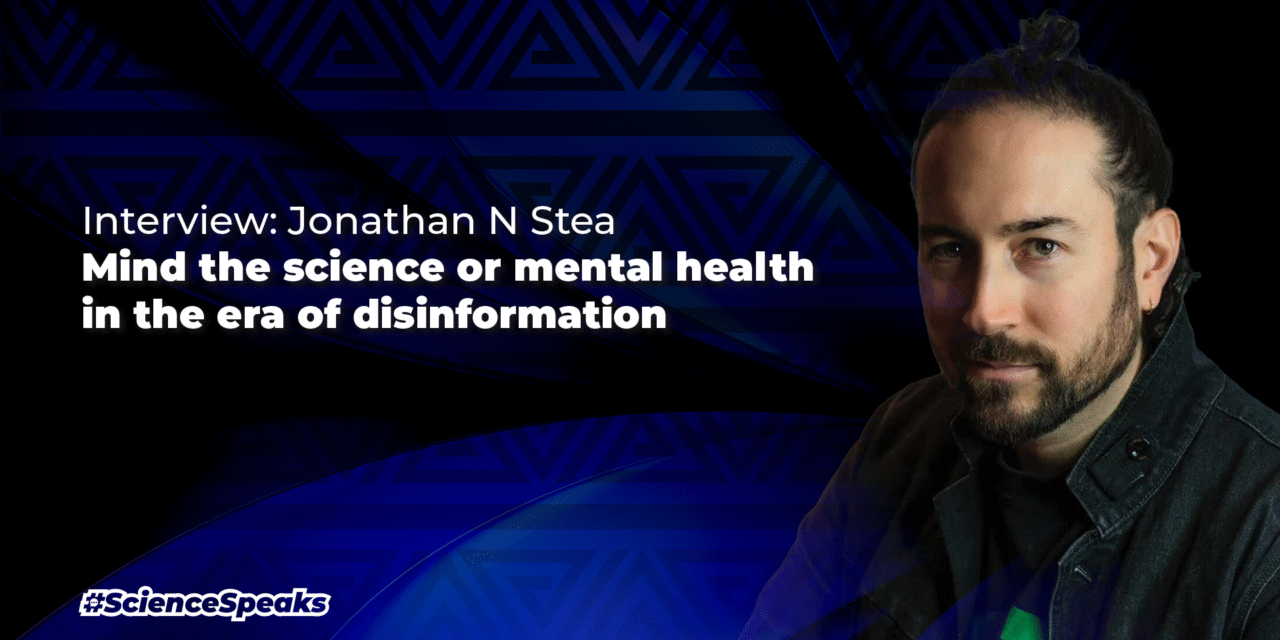
In a world where mental health has become a marketplace for quick fixes, viral “therapies”, and loosely defined wellness trends, the voice of experts who can clearly distinguish science from pseudoscience has never been more crucial. Dr. Jonathan N. Stea, a clinical psychologist and adjunct assistant professor at the University of Calgary, has dedicated his career to that mission — protecting the public from misleading approaches in mental health care. A two-time recipient of the University of Calgary’s Award for Excellence in Clinical Supervision and co-editor of Investigating Clinical Psychology, he is also a widely recognized science communicator, contributing regularly to Scientific American, Psychology Today, CBC, The Toronto Star, and The National Post.
In his new book Mind the Science, Dr. Stea tackles an increasingly urgent question: how can we identify and reject pseudoscientific treatments that spread through social media, the wellness industry, and popular culture? In this interview, he reflects on the personal motivations behind his advocacy, the most common deceptions he encounters in clinical practice, and the real dangers that arise when human vulnerability meets bad science. His message is clear — protecting our mental health begins with knowledge.
About the book Mind the Science and motivation
Science speaks: What personal or professional experiences motivated you to write Mind the Science?
Jonathan N Stea: I embarked on this mission because I’ve seen so many people hurt by pseudoscience. I wrote this book to empower people to take their mental health into their own hands and to protect themselves against the onslaught of bogus mental health treatments and products that have increasingly flooded social media, popular media, and the business of healthcare itself. I wanted to create a resource that could be understood and used by everyone and wanted to teach the language of pseudoscientific grift so that people know when it’s spoken. This is a kind of mental health support I’m unable to provide in the role of clinician.
Psychologists also have an ethical duty and responsibility to society to promote and practice evidence-based patient care. This ethical duty is the inspiration for my science advocacy work, and it necessarily involves shining a light on the harms of the wellness industry.
Science speaks: How did you choose which pseudoscientific practices to highlight in the book, given how vast the wellness industry is?
Jonathan N Stea: I decided to highlight some of the most popular categories of pseudoscientific approaches, such as energy healing modalities, naturopathy, chiropractic, and ayurveda when illustrating concepts. More importantly, however, I tried to emphasize that debunking specific pseudoscientific practices can feel like playing the arcade game Whack-A-Mole, where new ones keep sprouting up, which is why it is more fruitful for us to understand and address the underlying pseudoscientific features, as well as how to evaluate the credibility of scientific evidence.
When speaking about pseudoscience, it’s important to define what it means. The question of how to draw the line between science and pseudoscience is known in the history and philosophy of science as the demarcation problem. It’s important to understand that there’s no single criterion that draws the line between science and pseudoscience — rather, identifying pseudoscience becomes a matter of probability: the more warning signs we see, the greater likelihood that we’re looking at pseudoscience. Some warning signs include: an over-reliance on anecdotal evidence; claims divorced from the broader scientific literature; reversing the burden of proof; scientific-sounding but nonsensical language; a focus on confirmation rather than refutation; explaining away negative findings; evasion of peer review; absence of self-correction; and applying claims to an endless list of health conditions.
Understanding how to identify and avoid pseudoscience are paramount to making informed decisions about one’s mental health.
Science speaks: Were there any surprising or unexpected “therapies” you came across during your research?
It’s hard to pin-down just one outlandish claim because honestly, I see them on social media daily. They do, however, come from a few non-mutually exclusive sources. The anti-vaccine movement and the modern anti-psychiatry movement are pseudoscientific assaults on public health. Additionally, the wellness and alternative medicine industries financially exploit people’s health and emotional vulnerabilities by commodifying pseudoscientific treatments. The result is that we see absurd claims such as denying the existence of germs and mental illness, but promoting the existence of human energy fields, homeopathic water memory, and telekinetic spoon bending. We see dangerous claims that vaccines cause autism and psychiatric medications are more harmful than helpful, and that the solution is to follow a fad diet or buy unsupported supplements to address a faux “root cause.”
On pseudoscience and harm
Science speaks: Why do you think pseudoscientific treatments for mental health remain so attractive to people, even when evidence shows they don’t work?
Jonathan N Stea: The reality is that people fall for misinformation and pseudoscience due to the interaction of a variety of factors at individual, social, and systemic levels. At the individual level, science literacy, critical thinking, and intelligence are definitely important with respect to not succumbing to misinformation, but they’re only part of the puzzle. Even highly intelligent people can fail to think critically about information, especially when they aren’t motivated to do so and believe they’re right. In fact, some research even shows that intelligent people may have a somewhat larger bias blind spot than others, meaning that the smartest people may be less aware of their own biases. At this individual level, many other variables come together and interact that place people at risk, such as their tendency toward conspiracy mentality, how high they score on a particular personality trait known as openness to experience, their tendency to believe pseudo-profound bullshit statements, their reliance on an intuitive thinking style, their lack of intellectual humility, and their mistrust of institutions and health care providers. At the social and systemic levels, we are at the mercy of even more factors that influence our thinking and the kind of information that we see, such as social media algorithms that favor emotion-laden and oversimplified posts, and bad actors and organizations that explicitly target us with misinformation in the service of their own interests.
Science speaks: In your clinical work, what are the most common harms you’ve seen in patients who turned to pseudoscientific or alternative treatments? Do you see differences in how pseudoscience spreads in mental health compared to other fields of medicine?
Jonathan N Stea: Pseudoscience is harmful in at least 3 ways: it can directly cause harm, it can indirectly deprive time and resources from evidence-based treatments, and it can erode the scientific foundations of professions and institutions that promote its use. Patients deserve safe, ethical, competent care — not the potential harm and unethical grift that we see in the wellness industry.
There’s an estimated 600 brands of psychotherapy circulating in the world of mental health and that number is growing. Many haven’t been tested so we don’t know if they work; and many are pseudoscientific and could be harmful. More broadly, many pseudoscientific treatments are also unethically promoted in the wellness industry by people without any expertise or credentials, using legally-non-protected titles (depending on particular countries and jurisdictions), such as “therapists,” “counsellors,” and “wellness coaches.”
On the wellness industry
Science speaks: The wellness industry is worth trillions of dollars. Do you think it is possible for any part of this industry to coexist with evidence-based care, or is it inherently exploitative? How does marketing play a role in convincing vulnerable people to buy into pseudoscientific mental health “treatments”?
Jonathan N Stea: The wellness industry itself has come to represent a wonderland free from the constraints of scientific scrutiny and its beating heart flows with pseudoscience. It’s the commercial home to the alternative medicine industry. One message that I try to make clear in the book is that commodified alternative medicine is an ideology. It’s not merely a set of unsupported and pseudoscientific health practices that prosper at the borders of evidence-based health care. Rather, baked into alternative medicine are moralizing attitudes handed down from the early evolution of the wellness industry. It has its own tropes (i.e., repeated ideas or themes) to propagate distrust in mainstream health care, and its own fallacies to cajole audiences, and it also shapeshifts in its name to sneak pseudoscience into the health care system at large. Alternative medicine inherently elevates pseudoscience in its commercial form as part of the wellness industry and it’s a front for selling the fruits of fake science. To succeed, a polarizing narrative is required to perpetuate mistrust in health care that’s never out of vogue.
Science Speaks: What do you see as the most dangerous trend right now in the wellness or alternative medicine space regarding mental health?
Jonathan N Stea: While science is a process without borders, it can certainly become politicized. So too can pseudoscience, which we’re now witnessing firsthand with the rise of RFK Jr as US Secretary of Health and the Make America Healthy Again (MAHA) movement. This threat extends far beyond mental health to global public health. The shutting down of US grants and research programs, and the firing of scientists, does tremendous damage not only to the scientific community, but it will also worsen health outcomes in the long run globally. We’re already seeing the negative consequences in the US with measles outbreaks that are the result of the fear-mongering and propaganda promoted by the anti-vaccine movement (RFK Jr has been a leading anti-vaccine activist for decades). The anti-vaccine movement has had an ongoing love affair with the wellness industry dating back to over a century.
On solutions and moving forward
Science Speaks: How can the average person, without a scientific background, critically assess whether a mental health therapy is evidence-based?
Jonathan N Stea: To strengthen our grift detectors, we need to learn the warning signs of pseudoscience that I alluded to earlier in the interview, and we need to become well-acquainted with alternative medicine propaganda tactics and tropes. In my book, Mind the Science, I provide lists of these warning signs, tactics, and tropes, and I explain them in depth. I strongly encourage people to get to know them and to even memorize them if they can. The more warning signs, tactics, and tropes that people see and hear with respect to a particular mental health treatment or practice, the more likely it becomes that hype is being promoted, not evidence or accuracy.
When searching for quality mental health information online, it’s just as crucial to recognize what to avoid as it is to know what to seek. The very first step is to decide what kind of material you’re looking for, which could include ways to improve mental health on your own, or general information about the nature and treatment of mental disorders, or the assistance of local mental health professionals. In latter case, it can be helpful to have some questions in your back pocket and ready to go for an initial call with a potential practitioner or even your first couple of appointments. It’s important to ask about a variety of topics such as their credentials; the kinds of mental health concerns they specialize in treating; the kinds of mental health concerns that are beyond their scope of practice; their clinical experience; the length of time they’ve been licensed and practicing; their familiarity with evidence-based treatments and the science behind them; and practical items such as the number of sessions, fees, and attendance policy. I empathize with the frustration of having to put in the work to find effective care when one is feeling at their lowest and most vulnerable. And at the same time, the world of mental health care is very much caveat emptor: buyer beware. And your mental health is on the line.
Science Speaks: What role should governments, regulators, and professional organizations play in protecting the public from predatory pseudoscience?
In your opinion, how can the scientific and medical community communicate more effectively to counter misinformation?
What gives you hope that evidence-based mental health care can push back against the massive pseudoscience industry?
While it’s the mandate of regulatory bodies of various health professions to protect the public from harm, my message is perhaps a counterintuitive lesson: We cannot rely merely on care providers and regulatory bodies to protect our mental health. The onus is also on us to empower ourselves with knowledge, such that we can protect ourselves from mental health scams, charlatanry, and poor or misguided health practices.
The truth is that I don’t have any silver bullets to offer as solutions at the structural and systemic levels. I’m not a public health policy expert, nor am I a journalist, sociologist, political scientist, or economist. As such, it’s beyond my scope to deep dive into these problems, and I refuse to feign expertise. But from the perspective of a full-time practicing clinical psychologist with a foot in academia who works at the level of the individual, the best thing I can offer is guidance on bulletproofing yourself against pseudoscientific grift and seeking out best-in-class mental health care that is within your control.
On the human side
Science Speaks: Many people seek alternative therapies because they feel unseen or rushed in the traditional health system. In my part of the world, it usually connected to corruption in health system (people sometimes have to give money or presents for certain intervention, to “take care” of doctors and nurses) and overall corruption in system as well as weaknesses in public health (not enough physicians, sometimes health workers are underpaid, health care coverage for some therapies) How can evidence-based care respond to this gap in empathy and time?
Jonathan N Stea: The seduction of pseudoscience runs deep, right to the psychological, social, and cultural lenses through which we view our world. An unfortunate reality is that not all legitimate treatments work for everyone and even some of our best evidence-based treatments won’t be helpful for many people. It would be absurd to blame someone for seeking alternatives. And at the same time, research suggests that even more important to alternative medicine seekers than being dissatisfied with mainstream health care is finding pseudoscientific practices that are more congruent with their own values, beliefs, and philosophical orientations. If we simply ask people why they use alternative medicine, they’ll tell us. They’ll say that natural treatments are better than chemical ones, that mainstream health care professionals don’t spend enough time with them, they aren’t viewed as a whole person, they want to avoid the side effects of medications, the pharmaceutical industry is solely profit driven, among other very justifiable and understandable reasons. We’re also captivated by fake science news for other psychological and social reasons, such as being victims of our own cognitive biases, the structure of online social networks, and being preyed upon with misinformation and propaganda by grifters and organizations. What’s more, not everyone has access to effective treatment in the first place, and widespread systemic barriers in mainstream health care also play a major role in the triumph of pseudoscience, leading to a lack of easy access to quality care, especially among minority and underprivileged groups. This allows pseudoscience peddlers to slither in and open for business—and to say that a wellness industry worth $5.6 trillion is lucrative would be an understatement.
All that said, gaps in health care signal a call to fill those gaps with ethical, equitable, competent science and patient care. Gaps in health care don’t justify filling those gaps with exploitation and pseudoscience masquerading under the banner of wellness and alternative medicine.
Science Speaks: If someone close to you were considering pseudoscientific treatments for their mental health, what would you say to them?
Jonathan N Stea: In clinical practice, mental health professionals must be willing to navigate misinformation in a way that adheres to evidence-based practice, respects patient autonomy, ensures safety, and empathically preserves therapeutic relationships. This delicate dance is not easy, but it’s necessary, and good clinicians have been trained to do so.
It can feel frustrating when misinformation shows up in personal relationships. When navigating misinformation outside of clinical practice with those who you care about, how you engage will depend on your intention—is your goal to change minds or preserve relationships? How you engage will also depend on the unique interpersonal dynamics — or way of interacting — that you have with that person. It can sometimes be helpful to give credible, evidence-based information on the topic, and it’s important to communicate in ways that express empathy, concern, and care.

This article was produced within the framework of the European Union project “Raising awareness and knowledge of scientific literacy in BiH”. Its contents exclude the responsibility of the author and do not necessarily reflect the views of the European Union.