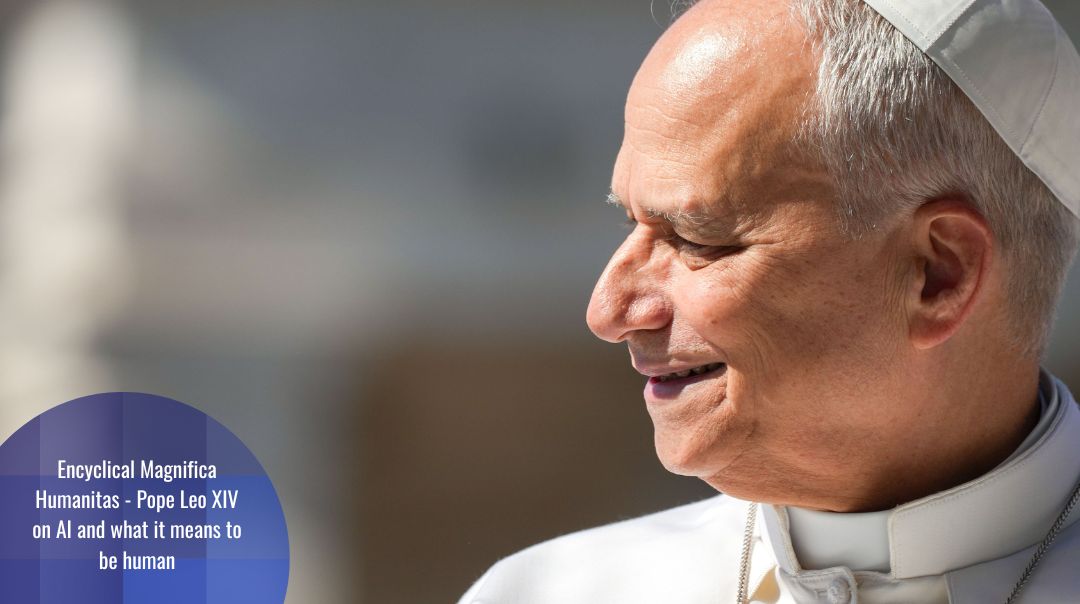
Marking the 135th anniversary of the encyclical Rerum novarum, Pope Leo XIV issued his first encyclical, Magnifica humanitas: On the Protection of the Human Person in the Age of Artificial IntelligenceThe encyclical Magnifica Humanitas, or, in translation, Magnificent Humanity, was published on 25 May 2026. In it, the Pope called for the protection of humanity, the promotion of truth, the dignity of work, social justice and peace.

Incidentally, the aforementioned encyclical Rerum novarum is an encyclical published by Pope Leo XIII, the predecessor of the current pope, on May 15, 1891, and concerns the relationship between the working class, capital, and labor during the Industrial Revolution. Magnifica humanitas: On the Protection of the Human Person in the Age of Artificial Intelligence, or rather, on the Protection of Human Dignity in the AI ​​Era, nicely builds on Rerum novarum in a new context, but also on Pope Francis’ 2015 encyclical Laudato si (Praise be to you), which addressed climate change as another urgent problem facing humanity. Even more significantly, this is the first encyclical of Pope Leo XIV (real name Robert Francis Prevost), which gives it added weight. 

Some media outlets and authors have called this text the Vatican AI manifesto. Some have interpreted it as the Pope's message that AI is not bad, and some have interpreted it as the Pope's criticism of artificial intelligence and a warning. However, it is very difficult to take the time today to go through at least some of the five chapters of this encyclical of about 200 pages. The story of artificial intelligence is only one part of the message. The larger part actually concerns the questions of the importance of truth for democracy, the place of man and what man is.

It is interesting that Pope Leo XIV in Chapter 5, entitled The Culture of Power and the Civilization of Love, under the section Building a Civilization of Love – Each of us can do our part, quotes Tolkien's Lord of the Rings, a favorite work of AI despots, especially Palantirovans:

“The twentieth-century Catholic author, JRR Tolkien, in the words of the protagonist of one of his novels, described our responsibility this way: ‘It is not our task to master all the tides of the world, but to do what is in us for the good of the years in which we are placed, eradicating evil in the fields we know, that those who live after may have a clean earth to till.’”

Pope Leo XIV warns that the development of artificial intelligence and digital technologies must not lead to power and control being concentrated in the hands of a small number of people. Such a situation would further deepen the differences between those who have access to the digital revolution and those who are excluded from it.

The Pope emphasizes that technology, although it can bring progress, must serve the common good and not the interests of narrow economic and political elites. In particular, he warns of the risk of AI becoming a tool for creating new forms of inequality and social exclusion.

In the encyclical, AI is seen as a tool whose effect depends on how it is used and who controls it. But in fact, sometimes this tool is in the function of human degradation and that is its only role – as an Undress application. The Pope calls for a fairer distribution of digital resources, greater transparency and international responsibility in the development of technologies.

Essentially, the message of the encyclical is that the digital revolution must be inclusive and human-centered. If left to the unchecked power of the market and big tech companies, it can lead to new forms of inequality and exclusion, instead of the promised progress for all.

In this encyclical, the first pope born in the United States presents one of the most important messages of his pontificate: technological progress, especially the development of artificial intelligence, must be aimed at preserving human dignity and the common good, not at deepening social divisions.

The Pope starts from the insight that humanity is in a moment of accelerated digital transformation that is changing the way we work, communicate and make decisions. According to him, artificial intelligence is increasingly taking over functions that were previously exclusively human, from data analysis to making complex decisions. However, he makes a clear distinction between man and machine: AI can imitate certain thought processes, but it does not possess consciousness, experience, emotions, or the ability to reason morally.

In this context, the pope warns that it would be dangerous to equate human intelligence with algorithmic data processing. A human being, he emphasizes, is formed through relationships, suffering, joy, responsibility and moral choices, while artificial intelligence systems do not “live” any of that. This is why technology cannot be allowed to become a substitute for human decision-making in key social and ethical issues.

One of the central parts of the encyclical refers to the issue of power and inequality. Pope Leo XIV warns that the concentration of advanced technologies in the hands of a small number of corporations or states could create a new kind of global divide – between those who have access to digital tools and those who are excluded from them. Such a division would not only be economic, but also social and political, as it would determine who has a voice and influence in the modern world.

He therefore calls for greater fairness in the development and distribution of technology. According to the encyclical, the digital revolution must not become the exclusive domain of the privileged, but the common good of humanity. This implies international cooperation, ethical frameworks and responsibility of technology companies that develop artificial intelligence systems.

In the Culture of Power section, he clearly warns against the normalization of warfare, to which the circles of the American administration have surrendered under the strong influence of charismatic Christianity (for example, the sermons of Trump's spiritual guide Paula White-Cain are full of calls for hatred and destruction and often have the smell of Gilead from The Handmaid's Tale. He also warns of changes in the balance due to the weaponization of artificial intelligence, as well as the tragic crisis of multilateralism, which has been completely abandoned as part of the sophisticated rules of diplomacy with all these wars, the start of a war against Iran, the cancellation of USAID's international aid and the financing of a series of UN projects. Of course, the pope does not name all of this, but it is clear what he means when he writes about the crisis of multilateralism. It is about the desire for absolute power, the absence of culture, and a terrible Machiavellian scale of corruption, where one group of people only stockbroker toy stocks, arms trade and where small lands are given as rewards for services to ruling structures.

These vulgar people, like in the magnificent series The Boys, have proclaimed themselves first superheroes and then gods. This idolatry, the building of a golden calf, is not only blasphemy of the worst kind, a darkness that many blinded by the wealth of neoliberal capitalism and the free market could not see, the dark sides of humanity, but also a warning of how easily societies can abandon their own moral compasses when success and wealth begin to replace virtues, and power becomes an object of worship instead of questioning.

Referring to the Gospel of John 1:5, Pope Leo XIV writes: “Christians see the darkness and recognize it for what it is, but they do not merely look at it passively, for they know the light and understand that darkness has not overcome it and cannot overcome it (cf. Jn 1:5).”

A particularly important part of the document refers to the criticism of the “logic of dominance” that often accompanies technological development. The Pope warns that AI should not be developed in the context of a race for power, profit and geopolitical control. Instead, he advocates the “disarmament of technology”, which does not mean rejecting innovation, but freeing it from the logic of conflict and competition. Pope Leo XIV insists on the need to ensure that technologies are not concentrated in the hands of a small number of people, as this could further widen the gap between those who have access to the digital revolution and those who are excluded from it.

The Pope calls for compassion, for accepting the perspective of the victims, for not normalizing conflicts and not turning a blind eye when human dignity is threatened.

Finally, the encyclical Magnifica Humanitas offers a vision in which technology remains subordinate to man, not the other way around. Pope Leo XIV insists that the key task of the modern age is to preserve humanity in a world that is rapidly becoming automated. Artificial intelligence can be a powerful tool for progress, but only if it is developed in accordance with ethics, solidarity and respect for human dignity. Unfortunately, the Vatican Bank does not follow the wisdom of this encyclical: as reported by El Pais, the Vatican Bank (Institute for Religious Works), although it does not publish its investments, in cooperation with the financial company Morningstar publishes indexes of companies it considers compatible with Catholic values. Among them are Meta, Microsoft, Amazon, Alphabet and Tesla – just some of the leading companies in the development of artificial intelligence, cloud infrastructure and digital technologies.

When the Pope mentions transhumanism, posthumanism in the encyclical (Conclusion, 232), he concludes at the end of that specific passage: “What saves humanity is divine love that descends to the most fragile point of our history and renews it from the inside.”
Or perhaps, in the words of Dostoevsky – “Beauty will save the world.”
  Author:

Jelena Kalinić, MA in comparative literature and graduate biologist, science journalist and science communicator, has a WHO infodemic manager certificate and Health metrics Study design & Evidence based medicine training. Winner of the 2020 EurekaAlert (AAAS) Fellowship for Science Journalists. Short-runner, second place in the selection for European Science journalist of the year for 2022