The digital ecosystem known as the “manosphere” encompasses a variety of online communities—from self-help forums, through various alpha-male-pseudo-stoic self-work content to more extreme incel and “red pill” groups — that share specific narratives about men, women, and relationships. Although not all these communities are the same, research shows that in many of them disinformation is systematically spread, often wrapped in pseudoscientific language to make it seem convincing.
At the heart of these narratives of the manosphere are recurring myths – particularly those that justify misogyny or portray women as threats to men.
The Myth of “Female Hypergamy”
One of the most widespread narratives is the claim that women are “hypergamous by nature” – that is, that they are constantly looking for partners of a higher status and that they are inherently dissatisfied. This concept is often associated with the idea of the so-called “dual mating strategy”, which is interpreted in the manosphere as proof that women cheat and manipulate their partners.
However, the scientific literature shows a much more complex picture. Evolutionary psychology offers several competing hypotheses about human behavior, none of which confirm this simplistic narrative. Moreover, research shows that both men and women express a desire for partners of a higher status, but that in reality most relationships are formed between people with similar characteristics – a phenomenon known as “assortative mating”.
In other words, the idea that only women are “hypergamous” is not empirically based – it is the result of a selective interpretation of the data.
One of the strongest empirical findings in sociology and evolutionary psychology that this manospheric claim is not true is a study in the journal Evolution and Human Behavior that shows that people globally choose partners similar to themselves on multiple dimensions (education, status, desirability). This pattern has been confirmed in large samples (more than 14,000 respondents in 45 countries). And in this study, it was shown that kindness and intelligence – something that is not really present in the manosphere community – are found in each other.
The “80/20 Rule”: A Popular but Inaccurate Narrative
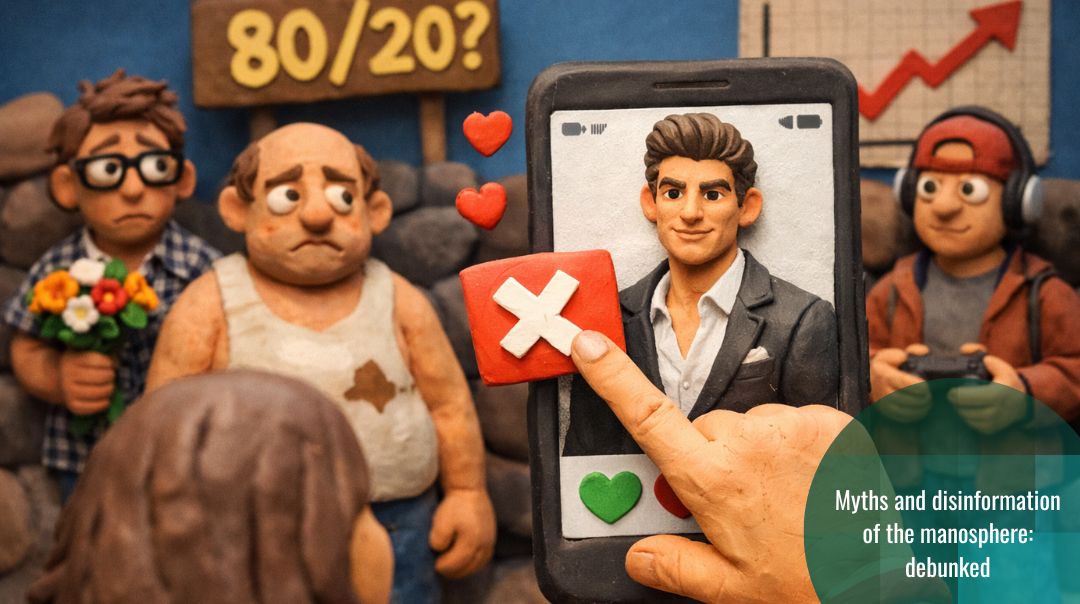
Perhaps the most famous myth from the manosphere is the so-called “80/20 rule” – the statement that 80% of women want only 20% of men. This idea is often presented as scientifically “proven” by analyzes from dating apps. It is also mentioned in the series Adolescence.
However, recent research suggests the opposite. An analysis of the behavior of users of a European dating application showed that men more often target partners who are “above their level” (ah, talk about trophies), while women mostly choose partners of similar desirability. Also, successful relationships are most often formed between people with similar characteristics, and not through extreme concentration of attention on a small number of “most desirable” men. Besides, what is the “most desirable man” according to men, is not necessarily the most desirable according to women.
There is no relevant peer-reviewed study that confirms this claim in the context of human relationships. But there are several works that indirectly show why it is wrong.
One of the sources of myths are analyzes from applications like OkCupid or Tinder. An early OkCupid blog (not a peer-reviewed study, mind you!) showed that women rate most men as “below average.” But a key detail that the manosphere ignores is that women were still texting a large number of these men. The conclusion from later analyzes is that perception is not the same as behavior, and that the interaction is not reduced to the elimination of 80% of men. And let's never forget – Monica Bellucci was with Vincent Cassel, and Jane Birkin was with Serge Gainsbourg.
Studies That Disprove 80/20
One of the most important studies (2) on online dating is Bruch & Newman (2018, Science Advances), in which the behavior of thousands of users was analyzed. People – both men and women, not just women as manospherists claim – do try to contact more “desirable” partners, but most interactions and connections occur between people of similar desirability. In other words, the pot finds a lid and rejoices like like. The key conclusion is that there is no “winner takes all” dynamic — the system is not 80/20.
There are studies like Conroy-Beam et al. (3), Eastwick et al (4), who show that long-term relationships are achieved by similar partners and that there is no extreme concentration of attention on a small number of men. This directly refutes the idea that 80% of women choose only 20% of men.
This myth persists because it is based on the misinterpretation of limited data (eg swipe behavior), which do not reflect real relationships and long-term relationships.
In the context of dating apps, “swipe behavior” refers to the way users quickly evaluate potential partners by swiping profiles left or right — most often on apps like Tinder, Bumble, or Hinge, and which often results in a superficial evaluation because there is no time on the apps to delve deeper into the person.
There is also a mathematical problem with the myth itself – if the “80/20 rule” were true, then 80% of women would remain without a partner or a small number of men would have a huge number of partners, which is not in accordance with marriage rates, distribution of partnerships, demographic data.
In other words, the myth is statistically unsustainable at the population level. It's just that the manospherists want to keep him alive with their promotion of one-sided monogamy.
People do not choose from an infinite offer, but from real interactions.
Pseudoscience and “Cherry-Picking”
A key mechanism for maintaining these myths is the selective use of scientific studies. Research shows that members of the manosphere often cite evolutionary psychology, but draw conclusions that are not supported by the original work. They extract what suits them and interpret as suits them.
For example, theories about female sexuality are often simplified into extreme claims of infidelity or manipulation, even though empirical data show great variability in behavior among individuals.
This process – known as “cherry-picking” – enables complex scientific results to be turned into ideological slogans.
The Myth of “Manipulative Women”
Another common narrative is that women systematically manipulate men – through sex, emotions, or marriage. This discourse often includes dehumanizing language and the representation of women as a homogeneous group with the same motives.
Yet psychological research shows that gender relations are shaped by a wide range of factors—including culture, economics, and individual differences—rather than simple manipulation strategies.
The Myth of “False Reports of Violence”
In the manosphere, it is often claimed that women falsely report sexual violence en masse. Manosphere claims that women report fake rape if a man they like or were with rejects or leaves them. Although individual cases exist, this narrative ignores the larger context and serves to delegitimize the actual victims.
Reviews of the literature (beyond the manosphere discourse) consistently show that false reports are relatively rare relative to the actual incidence of violence – but in online communities this relationship is often twisted to support an ideological agenda. Most research finds a range of 2% – 10% of false reports (6).
“The Crisis of Masculinity” and Anti-Feminism
Many manosphere narratives connect personal frustrations with the idea that feminism has “destroyed society”. This claim functions as a “grand narrative” that unites other myths – from hypergamy to discrimination against men. But in the manosphere, a woman is never good – either she's an independent feminist who destroys the traditional role of men, or she's a woman who just sounds something, or she doesn't want sex after giving birth, or she's gained weight, so she's unattractive. Basically, you understand – it's all up to the woman. Sarcasm.
While there are legitimate topics related to men's mental health or societal expectations, the problem arises when these challenges are explained through conspiracy theories or generalizations about women.
How Do These Myths Become Convincing?
Research suggests that social network algorithms can amplify exposure to this kind of content, even without actively seeking it out. In addition, studies show that participation in manosphere communities can gradually change users’ attitudes and increase the tendency towards more radical views. That is, like rejoices and strengthens like. Like when even good students get into bad company and get drunk, get drunk and become bad in general. Who you are with – that's who you are.
Psychological factors also play a role: men, on average, show a greater tendency to overestimate their own performance and selectively interpret information, which can make it easier to accept narratives that confirm existing beliefs.
Conclusion
Myths in the manosphere are not accidental – they represent a combination of misinterpreted science, algorithmic amplification and psychological needs for simple explanations of complex social problems.
Although some of these narratives begin as attempts to understand men's experiences, their transformation into generalizations and misinformation often leads to misogyny and social polarization.
Debunking these myths requires exactly what they are trying to imitate: a critical reading of scientific evidence, an understanding of context, and a rejection of simplistic explanations of human behavior.
Reference:
- Conroy-Beam, D., Roney, J. R., Lukaszewski, A. W., Buss, D. M., Asao, K., Sorokowska, A., Sorokowski, P., Aavik, T., Akello, G., Alhabahba, M. M., Alm, C., Amjad, N., Anjum, A., Atama, C. S., Atamtürk Duyar, D., Ayebare, R., Batres, C., Bendixen, M., Bensafia, A., … Zupančič, M. (2019). Assortative mating and the evolution of desirability covariation. Evolution and Human Behavior, 40(5), 479–491. https://doi.org/10.1016/j.evolhumbehav.2019.06.003
- Bruch EE, Newman MEJ. Aspirational pursuit of mates in online dating markets. Sci Adv. 2018 Aug 8;4(8):eaap9815. doi: 10.1126/sciadv.aap9815. PMID: 30101188; PMCID: PMC6082652.
- Conroy-Beam D, Buss DM. Do mate preferences influence actual mating decisions? Evidence from computer simulations and three studies of mated couples. J Pers Soc Psychol. 2016 Jul;111(1):53-66. doi: 10.1037/pspi0000054. PMID: 27337140.
- Eastwick PW, Luchies LB, Finkel EJ, Hunt LL. The predictive validity of ideal partner preferences: a review and meta-analysis. Psychol Bull. 2014 May;140(3):623-665. doi: 10.1037/a0032432. Epub 2013 Apr 15. PMID: 23586697.
- Eastwick PW, Sparks J, Finkel EJ, Meza EM, Adamkovič M, Adu P, Ai T, Akintola AA, Al-Shawaf L, Apriliawati D, Arriaga P, Aubert-Teillaud B, Baník G, Barzykowski K, Batres C, Baucom KJ, Beaulieu EZ, Behnke M, Butcher N, Charles DY, Chen JM, Cheon JE, Chittham P, Chwiłkowska P, Cong CW, Copping LT, Corral-Frias NS, Ćubela Adorić V, Dizon M, Du H, Ehinmowo MI, Escribano DA, Espinosa NM, Expósito F, Feldman G, Freitag R, Frias Armenta M, Gallyamova A, Gillath O, Gjoneska B, Gkinopoulos T, Grafe F, Grigoryev D, Groyecka-Bernard A, Gunaydin G, Ilustrisimo R, Impett E, Kačmár P, Kim YH, Kocur M, Kowal M, Krishna M, Labor PD, Lu JG, Lucas MY, Małecki WP, Malinakova K, Meißner S, Meier Z, Misiak M, Muise A, Novak L, O J, Özdoğru AA, Park HG, Paruzel M, Pavlović Z, Püski M, Ribeiro G, Roberts SC, Röer JP, Ropovik I, Ross RM, Sakman E, Salvador CE, Selcuk E, Skakoon-Sparling S, Sorokowska A, Sorokowski P, Spasovski O, Stanton SCE, Stewart SLK, Swami V, Szaszi B, Takashima K, Tavel P, Tejada J, Tu E, Tuominen J, Vaidis D, Vally Z, Vaughn LA, Villanueva-Moya L, Wisnuwardhani D, Yamada Y, Yonemitsu F, Žídková R, Živná K, Coles NA. A worldwide test of the predictive validity of ideal partner preference matching. J Pers Soc Psychol. 2025 Jan;128(1):123-146. doi: 10.1037/pspp0000524. Epub 2024 Oct 31. PMID: 39480282; PMCID: PMC12622239.
- Lisak D, Gardinier L, Nicksa SC, Cote AM. False allegations of sexual assualt: an analysis of ten years of reported cases. Violence Against Women. 2010 Dec;16(12):1318-34. doi: 10.1177/1077801210387747. PMID: 21164210.
Jelena Kalinić, MA in comparative literature and graduate biologist, science journalist and science communicator, has a WHO infodemic manager certificate and Health metrics Study design & Evidence based medicine training. Winner of the 2020 EurekaAlert (AAAS) Fellowship for Science Journalists. Short-runner, second place in the selection for European Science journalist of the year for 2022
Illustration was created using GAI tools