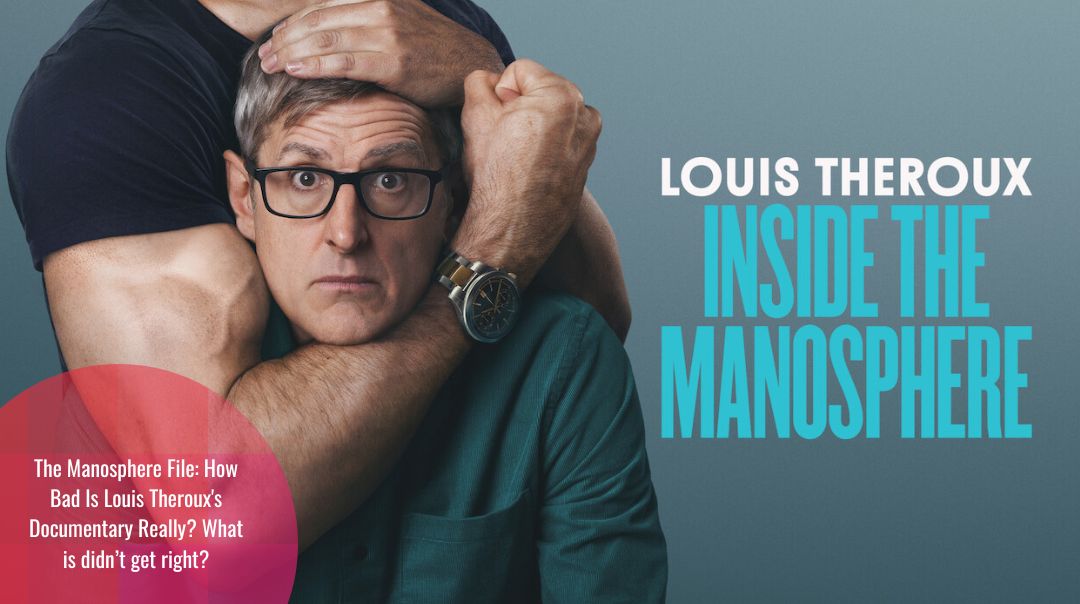
The documentary Louis Theroux: Inside the Manosphere is intended as a critical look at the online “manosphere”, but in its execution it remains sketchy and, paradoxically, partially normalizes what it tries to portray as a problem. Louis Theroux's signature style — unobtrusive presence, quiet listening, and avoidance of open confrontation — becomes a limitation here. We have a problem that requires analysis, reflection and a stronger voice. This is a consequence of that Western school of journalism, which only transmits and lets the audience decide, instead of establishing a strong voice. Even worse, the Western school of journalism would at least ask for two sides to be presented, but here only one is presented and thus, by not asking questions and not putting the other side, the visibility of what is a bad social phenomenon is increased. Instead of exposing the mechanisms of the manosphere, power and manipulation, the film often leaves the protagonists to represent themselves, without sufficient context or challenge. People who were unknown outside of that obscure online community are now known to all of us.
So, one of the key problems is the lack of balance of votes. Manosphere is an online community of misogynistic content-creators, men, so not artists, not intellectuals, but some kind of influencers who have freed themselves from responsibility by some unwritten rule and which promotes the idea that feminism is dangerous, that women should be in the kitchen, and various suprematist ideas and conspiracy theories and pseudoscience. Topics include gym, nutrition, women, intimate relationships, supplements.
While men in the manosphere are given space to elaborate on their views—often mitigating them with claims that they “respect women” or that women “choose their own traditional roles”—women's voices are marginalized and reduced to stereotypes. Only individual OnlyFans creators are shown, who are portrayed in a way that emphasizes uninformed and superficiality, thereby implicitly confirming the narratives of the manosphere. Let's say, these influencers show up to list several countries, and they don't know it, thus trying to show that women are intellectually inferior and that they don't deserve equality, but are only there to spread their legs, give birth and prepare and cook. Such a choice of interlocutors within the manospheric community, as well as the documentary itself, not only narrows the spectrum of women's experiences, but also undermines the possibility of serious debate.
Two partners of manospheric influencers are also shown, namely Kristen, Justin Waller's unmarried wife, and Miron's partner, Angie Camacho. These women in the documentary are truly voiceless. From reading between the lines and the way they keep quiet, it can be seen that they are not too happy with the deal that they are cheating on them, which is called unilateral monogamy. And there is no force in which Jason talks about how he loves and respects his partner and protects his daughters, which would convince us that this is ok for those women. Even when they say they are happy they don't have to wake up for work.
Missed Moments to Criticize Misogyny
And yes – we also had a mother, the mother of the hypocritical influencer HStikkytokky (Harrison Sullivan). His mother, Elaine, does not agree with her son's statements, his homophobia and attitude towards women, but she will defend him in front of Louisa like a true lioness mother and say that Thereoux also makes money from her son. Fair enough. However, HStikkytokky does not see the problem and his responsibility in being watched and followed by too young, not yet formed boys, that at the same time he despises women on Only fans and promiscuous women, but that he himself is the manager for Only fans creators. He believes that this is not a problem only because he publicly admits it and does not hide it. The lack of not only responsibility but also the idea of what responsibility means is sad.
But here too, Louis Theroux did not seize his chance – as they say in football parlance: what a missed opportunity!
Instead of exploiting problematic statements—such as when Stikky openly speaks out against women, or when Myron Gaines claims that “you never know when a woman's on her period”, and even the question “do you know anything a woman has created?”—Theroux misses an opportunity for serious analysis. These are the moments in which he could open a conversation about superficial and pathetic misogyny, often packaged as humor. He could show how such “comedians” actually try to act like dudes and gentlemen, but they fail. By the way, the definition of a comic character is one who tries something, but never succeeds.
He was also able to better and more deeply draw attention to their business models, which often have the characteristics of manipulation and get-rich-quick at the expense of the public. Instead, Theroux goes in a completely different direction — toward conspiracy theories, including the anti-Semitic narratives that have been around since Henry Ford was spreading ideas like “The Protocols of the Elders of Zion”. It falls into the trap of digression, including topics like Gaza and genocide, which remain insufficiently connected to the main story.
Because of this, he fails to lead the conversation in a clear direction. More importantly, it fails to explain how these attitudes affect young men who are just forming their worldviews—and what consequences they have for women.
Grifter Business Models of the Manosphere and Pyramid Schemes
The film also fails to explore the wider social consequences of the manosphere. There is no serious analysis of how these contents affect the normalization of misogyny, online harassment or even violence against women. Also missing is the context of how these ideologies can contribute to more extreme forms of behavior, including control, emotional abuse or exploitation through digital platforms. Also, there is no elaboration of the economic models behind individual influencers — often based on courses, “mentoring” and hierarchical structures reminiscent of pyramid schemes. Theroux himself admits in the film that he lost the money he invested in the recipes of these scammers – which he did as part of an experiment, it's the same as when you decide to enter a casino and then you have to decide how much money you're okay with losing. Because you won't get anything.
An opportunity was also missed to elaborate on how Myron Gaines’ Fresh and Fit podcast spreads pseudoscience, serves rote sentences with no background in scientific studies, and how through quasi-mentor advice on health, the gym, it draws young men into very dangerous things, schizophrenic thinking, hatred and contempt.
It is particularly problematic that the documentary does not include expert voices. Psychologists, sociologists or feminist theorists could provide an analytical framework for understanding the phenomenon: why the manosphere attracts young men, how it shapes their attitudes about gender relations, and what are the long-term consequences of such beliefs. Without these perspectives, the viewer is left with individual stories that may seem benign or even rational, even though they are part of a larger, problematic pattern.
There is no mention of how men today treat women like cartoons and trophies (and not just these guys, but a whole group of Balkanoid pro-lifers, and not just now but before), how they show each other pictures of women (including their sisters and mothers) from their phones or share them in groups, how men who have daughters share pictures of their mistresses and call women whores (“all women are whores, except my mother”, ah, that Balkan poetics) and use undress apps as a form of digital abuse of women.
Additionally, the connection to the political context, including closeness to movements like the MAGA movement, remains superficially indicated. Jason would love to be in the Trump inner circle, Tate is, and Sneako is deep in the worst Qanon conspiracy theories. This misses an opportunity to show how online misogyny is intertwined with political ideologies and broader cultural changes.
Thereoux didn't even try to find the ultimate grandfather of the manosphere – Jordan Peterson, that intellectual for stupid people, who advocated the traditional role of the sexes, whatever that means and poisoned young men with his shallow books, videos, statements, and then retired. And he didn't even manage to reach Joe Rogan, Andrew Tate and his brother Tristan, because they are apparently hiding because they ran prostitution rings, forced and incited them into prostitution.
It's good that Theroux brought up daddy issues – that most of these influencers have problems with their father figures. But just because someone grew up without a father, and their father was rough and absent, doesn't mean that that boy will grow up to be this way.
Still, the documentary has a certain value: its restraint allows us to see how the actors of the manosphere experience and represent themselves. But without a stronger authorial stance and critical framework, this approach risks becoming a platform rather than an analysis.
Ultimately, Inside the Manosphere fails to fully live up to its critical potential. Instead of exposing the power structures, manipulations, and harmful consequences of this online community, the film, although it lasts an hour and a half, remains on the surface—between fascination and mild discomfort—leaving viewers without a clear understanding of the depth of the problem it portrays. What makes this documentary worth watching is that it's a short overview of what the manosphere is without having to go to those influencers’ channels, pay to stream and give them views. It is a digested quick presentation that could be useful for parents and teachers to see what is happening on the Internet and what children should be protected from, what to talk about and what to explain that is not good.
Jelena Kalinić, MA in comparative literature and graduate biologist, science journalist and science communicator, has a WHO infodemic manager certificate and Health metrics Study design & Evidence based medicine training. Winner of the 2020 EurekaAlert (AAAS) Fellowship for Science Journalists. Short-runner, second place in the selection for European Science journalist of the year for 2022.