This is the new hype on social networks and podcasts – everyone is talking about longevity . This is not a new desire – only now we have more opportunities to realize it to some extent. The idea of the Fountain of Youth dates back to Herodotus, and it is artistically treated in paintings such as that of Lucas Cranach the Elder or in the film La giovinezza by Paolo Sorrentini. Today, multibillionaire and venture capitalist Bryan Johnson is trying to preserve youth and achieve longevity through extensive supplementation, diet and exercise programs, and his own son's blood.
Podcasters and influencers constantly use the opportunity to introduce the concept of longevity . The notorious Peter Attia, whose name is in the Epstein files and who, for the sake of being with Epstein, was not with his sick son in the hospital, who was dying, did not stop talking about longevity. There is also Andrew Hubberman, an influencer-professor at Stanford, who in his podcasts usually cleverly distances himself from interventions that he even applies to himself and says that there is no evidence for some or that we should not apply them, but we should still not forget that he belongs to the intellectual manosphere and pushes unproven supplementation under the grain by putting bugs in people's ears, although not everything he says is to be rejected or disinformation.
Investors are literally pouring money into start-ups that have something to do with longevity . Hype and investment in high technologies, research done by some super-rich people in order to achieve longevity also falls into the story of transhumanity, i.e. optimization of man and inequality – if only the rich can afford interventions that improve life expectancy and quality of life. But actually what really does the job is not ultra-tech and expensive.
Basically – you get the idea – the word longevity, or as it sounds cooler now , has become the new it topic. And how could it not – who doesn't want to look younger for their age, have more strength, not be sick, exhausted, be vital for as long as possible? I'm the first one like that and of course I'm trying to do interventions that promise to keep me vital for longer. Let the first one cast a stone and let's see the beam in my own eye. And that's exactly the trick – it's not about the desire for longevity, but the desire for youthfulness and vitality. No one actually wants to live a hundred years and be stiff and immobile.
The idea that we could “slow down aging” is no longer reserved for science fiction. The biology of aging has become a serious research discipline in the last 20 years, and the focus is on interventions that could extend life span (lifespan) or at least extend the period of health (healthspan). However, it's important to say right away: most of the strong evidence comes from animal studies, while data for healthy humans is still limited.
I'm presenting you with evidence of what works, which interventions are functional and effective, starting with those with less evidence, moving on to those for which there is the most evidence today. So, if you want to find out what really makes sense to do, read on.
mTOR and rapamycin: the pharmacology of aging
One of the central signaling pathways associated with aging is mTOR (mechanistic target of rapamycin), which regulates cell growth and metabolism. The drug rapamycin (ra pamycin, Sirolimus) inhibits this pathway and represents the most consistent pharmacological way of extending lifespan in mammals.
In programs like the National Institute on Aging Interventions Testing Program, rapamycin extended the lifespan of mice even when administration began in middle or old age. Meta-analyses confirm that the effect is robust across multiple species and the effects can be compared to that of a caloric restriction intervention. But – the emphasis is on the fact that these are animal studies! This is not a very high level of evidence. One meta-analysis (1,2) in mammals showed that the effect of rapamycin is better than metformin in prolonging life.
In humans, the situation is different. Rapamycin is an immunosuppressant used in transplants and certain diseases. It suppresses the activity of T and B lymphocytes by reducing their sensitivity to interleukin 2. Long-term use in healthy people carries potential risks (infections, metabolic side effects), and we have no evidence that it prolongs the life of healthy people. It is currently the subject of smaller clinical studies focused on functional outcomes, not mortality.
It is interesting that rapamycin got its name from the indigenous name for the Easter Islands – Rapa Nui, because the bacterium Streptomyces hygroscopiscus from which this compound was isolated was precisely from samples from these islands. The downside to this substance, even if it works this well on humans, is that you can't buy it as any over-the-counter supplement, it's a drug used to prevent transplant organ rejection and stenosis, and to impregnate coronary stents. The role of rapamycin in improving lifespan and vitality and the mechanism, ie how mTOR inhibition does it, are still not well understood.
Metformin: a promise without final confirmation
Metformin is one of the most commonly prescribed drugs for type 2 diabetes. In addition, one of the most frequently mentioned substances in the context of longevity. It works by activating AMPK ( AMP-activated protein kinase — an enzyme that acts as an energy sensor of the cell) and influencing glucose metabolism. Epidemiological studies have shown that diabetics on metformin sometimes have a lower-than-expected mortality rate, which has fueled the hypothesis that the drug may have a “geroprotective” effect.
However, when data from animal models are analyzed, the effects on lifespan extension are weaker and more inconsistent compared to rapamycin. In healthy people, there is no evidence that metformin prolongs life. The long-awaited TAME (Targeting Aging with Metformin) clinical trial is underway , but the final results are not yet available.
Metformin has strong support as a drug that improves health markers , but there is currently no strong evidence that it extends life in healthy people (3): “based on the available evidence, we conclude that the beneficial effects of metformin on aging and health span are primarily indirect, through its effects on cellular metabolism. These effects derive from its antihyperglycemic effects, improvement of insulin sensitivity, reduction of oxidative stress, and protective effects on endothelium and blood vessel function,” state the authors of a study published in 2021 in Frontiers in endocrinology (Lausanne).
You can't buy this drug without a prescription either. Neither metformin nor rapamycin are approved as supplements or drugs for anti-aging and longevity. Their safety for long-term use in healthy people has not yet been proven. So, forget it.
NAD+ boosters: biologically interesting, clinically unproven
Substances such as NMN (nicotinamide mononucleoid) and nicotinamide riboside target increasing the level of the coenzyme NAD+ (nicotinamide adenine dinucleotide) , which declines with age, as does the production of collagen, hyaluronic acid and coenzyme Q10 with age. Studies show that supplementation can increase NAD+ in the blood and influence metabolic parameters. However, there is no evidence of lifespan extension in humans, and long-term safety remains unclear.
It shows that NMN is slightly better and better absorbed than NAD+, which is only absorbed by about 20%. Precursors seem to be a better option. NMN is a precursor of NAD+ crucial for: mitochondrial function, DNA repair and activation of sirtuins (proteins associated with aging). This molecule is often associated with bombastic marketing names that push sales – biohacking , longevity booster and anti-aging . There is no evidence that this molecule works like that, research is ongoing.
Works from the laboratory of David Sinclair at Harvard Medical School strongly popularized this topic. And yes, Sinclair was at Hubberman's so they hyped this molecule. This is largely due to attracting investment in these studies to finally find out if this molecule has an effect, but they have created a bubble of demand for a substance for which we currently have no evidence that it works, although there is evidence that it is quite safe in the short term. We have no evidence of the safety of NMN and NAD+ in long-term use. The fact that they are naturally synthesized in the body is not 100% proof of safety – the same was thought for melatonin , so it turned out that long-term use has its own risks.
NMN is indeed a biologically plausible candidate , but we still have no long-term randomized studies, no mortality data, no evidence of actual life extension in humans or improvement in vitality. Currently, it is more of an experimental longevity supplement than a proven life extension agent. Some influencers (like Hubberman) swear by intravenous infusions with this coenzyme, but there is no clinical evidence that it is effective, it is done by experimental self-initiated intake, which Hubberman himself says causes nausea and that he felt bad while receiving it.
One preprint study on mice (4) showed that long-term administration of NMN improved the health span of mice and extended the median lifespan of females by ~8.5%. A study (5) published in 2016, also on mice, showed that NMN significantly alleviates the physiological signs of aging in mice. In humans, one study (6) found good tolerance to NMN and that NMN can improve age-related biochemical markers as well as prevent age-related muscle dysfunction, but direct effects on lifespan were not tested.
The large US Interventions Testing Program (NIA) has so far failed to show a robust lifespan extension for NAD+ boosters in rigorous models. This substance has been shown to actually help increase blood levels of NAD+, lead to modest improvements in insulin sensitivity in prediabetes, and have a possible effect on muscle function in the elderly. There are also indications that it may lower blood pressure, which may indirectly contribute to lifespan extension. However, current human studies of this substance are small and short-term.
Since 2022, the FDA has not allowed the free sale of NMN and NAD+ supplements – not because there is evidence of harm, but because they are currently in clinical trials investigating this very topic. In 2022, the FDA changed the regulatory status of NMN because it is the subject of pharmaceutical development, which has caused legal and market controversy. They have appeared on our market, and their origin is from China.
Intermittent fasting – occasional fasting
Preclinical findings suggest that intermittent fasting is good for improving cell health and reducing the accumulation of pathological proteins, but clinical evidence in humans is still limited. Intermittent fasting has its own risks and is not for everyone.
Animal studies have shown that intermittent fasting has an effect on improved longevity, cognitive functions in aging, and that it improves resistance to stress. Intermittent fasting acts on mechanisms that include mTOR pathway inhibition, AMP-activated protein kinase (AMPK) activation, increased autophagy (cellular recycling) and reduced oxidative stress. All this sounds plausible and for longevity, but!
In humans, there is no evidence that intermittent fasting extends maximum lifespan . We have no long-term RCTs (randomized clinical studies, high level of evidence ) that could show this. Although intermittent fasting has no effect on obesity, it has been shown to improve insulin sensitivity, reduce triglycerides and blood pressure, so these are indirect ways it can improve health.
In older adults, intermittent fasting can lead to an unwanted reduction in muscle mass, and greater muscle mass is key to longevity. So intermittent fasting may have a negative effect on longevity in this way .
Some research suggests that aggressive fasting can, especially in women, disrupt the menstrual cycle, increase cortisol, and worsen stress sensitivity. The effects are individual, but these are also effects of intermittent fasting that can indirectly have the opposite effect to the desired one.
In some people, intermittent fasting leads to compulsive overeating in the “feeding window” and deterioration of the relationship with food, which is again counterproductive.
Intermittent fasting can lead to a decrease in androgen markers (testosterone and free androgen index) and an increase in SHBG in premenopausal women with obesity, and to a decrease in testosterone in young, physically active men, which can negatively affect metabolism and libido (10).
Caloric restriction: the most consistent experimental finding
The most robust intervention in the biology of aging is caloric restriction — a moderate reduction in caloric intake without malnutrition. In different models (yeast, rodents, primates) life span extension and improvement of metabolic health have been demonstrated. In fact, it is the folk one – god has given you a certain amount of food that you can eat in your life and if you eat it sooner, you will die sooner.
In humans, long-term randomized studies of life extension do not exist (because they would take decades), but shorter studies show improvements in markers of cardiovascular health, insulin sensitivity, and inflammatory parameters. However, strict caloric restriction is not simple or without risks (loss of bone mass, hormonal changes, impact on slowing down and reduction of basal metabolism), so it cannot be lightly recommended as a universal strategy.
Caloric deficiency and intermittent fasting should be distinguished. Although intermittent fasting should lead to caloric restriction, this is not always the case, if people overeat during the period when they do eat. It is better to reduce the total daily intake of calories than to make periods of not eating and taking food.
Diet, exercise and lifestyle: the strongest evidence in humans
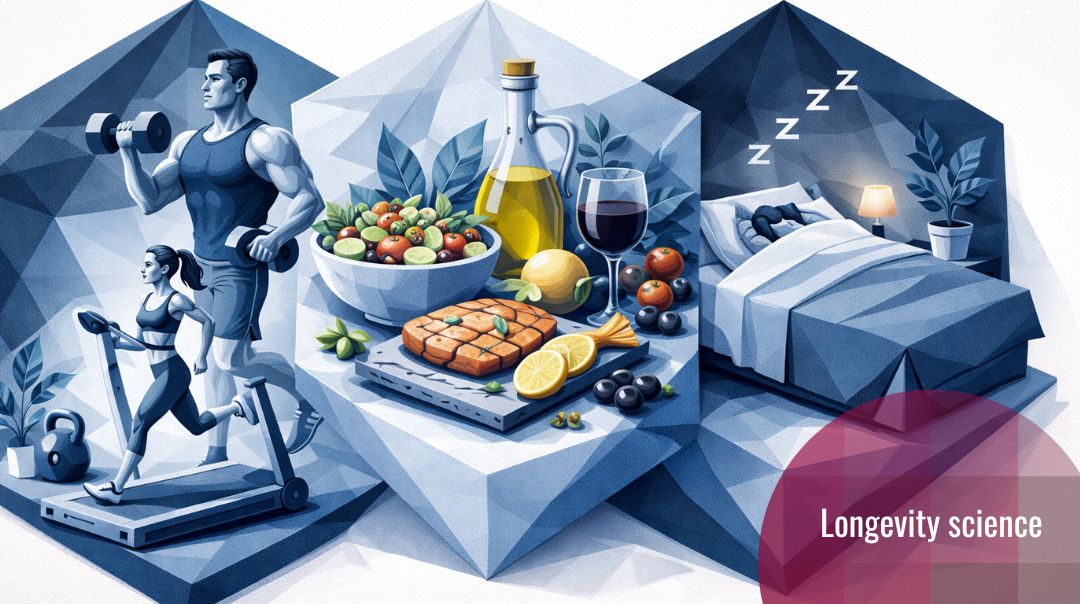
Unlike pharmacological interventions, the evidence for certain behavioral patterns is much stronger. A Mediterranean diet , a Mediterranean lifestyle, regular physical activity (aerobic and resistance training), adequate sleep, and avoidance of smoking are consistently associated with longer life and a lower risk of cardiovascular and neurodegenerative diseases. It should be added that alcohol avoidance and socialization are also important factors. A solitary lifestyle is associated with a higher risk of dementia, disease in general, and a shorter lifespan.
A Grande study from UK Biobank suggests that small positive changes in multiple areas can significantly increase life expectancy. This includes a few minutes more sleep, a few minutes more exercise (7).
Some supplements work, and these are not exotic extracts. A large clinical study from Nature aging published in 2025 (8) shows that a combination of omega-3 fatty acids, vitamin D and exercise can slow biological aging according to epigenetic markers.
A study (9) that analyzed the frequency of supplementation in people over 100 years old provides valuable information about what long-lived people actually use. This does not mean that what they take in supplements is causally related to longevity – perhaps it is just a correlation. Maybe it's people who have otherwise good protective genes like p53 and it just happened by chance that they were taking some supplements – and they were fairly widespread supplements. These supplements are also taken by people who get sick and live shorter lives – they are mostly calcium, iron, multivitamins and zinc. So, this is just an insight into the fact that these supplements work somewhat, but if you don't have any other risk factor. This study is on its way to publication, according to the reference data.
Another intervention helps – vaccination. And especially vaccination against flu, pneumococcal and whooping cough, but in general against all diseases. HPV vaccines reduce the risk of some forms of cancer, thereby increasing life expectancy, and in the elderly, infectious diseases such as influenza and pneumonia can cause exhaustion and dehydration that can lead to death or cognitive decline. Vaccination against herpes zoster reduces the risk of dementia by 28% over the next 7 years. Vaccination against influenza reduces the risk of death from cardiovascular causes.
There is also taking care of the teeth and gums: gum infections – gingivitis, periodontitis/periodontitis are associated with a higher risk of cognitive decline. Clean tartar regularly, even the one under the gums, use dental floss and toothpaste, take care of caries and gums.
We should not forget that we owe a lot of our longevity to our genes.
Although these interventions do not “turn off” aging, they reduce the likelihood of developing the diseases that most often shorten life. In other words, extending healthspan is currently a more realistic and evidence-supported goal than dramatically extending maximum lifespan.
Conclusion: caution and realism. Cheap and free interventions are the most effective
The biology of aging is an exciting field, but it is important to separate experimental results from clinical reality. Rapamycin has strong evidence in animals, metformin has epidemiological indications, and NAD+ boosters are still in the early stages of research. However, no pharmacological intervention currently has strong evidence that it extends life in healthy people.
For now, the most credible strategy for longevity remains a combination of a balanced diet, physical activity, and this should especially emphasize basic movements (squatting, lifting, lunging, working with weights, aerobic training), quality sleep and control of chronic risk factors. Everything else – although scientifically interesting – still belongs to the domain of research, not routine application. In fact, what is most effective does not involve expensive and exotic interventions – the most effective are free and cheap things.
A proper diet full of fruits and vegetables and a good consultation with a trainer about which exercises to do and how to do them correctly, mastering the basics, are more valuable than some expensive measures. If you have never exercised before and are afraid of all those movements and devices – consult with someone, sign up for group training to master the basic movements and exercises properly. And here you should rather look for a person with experience and a coaching diploma – someone who has graduated from a faculty of physical education – kinesiology, and not someone who is a trained coach and only has a certificate.
If you need a person to advise you regarding nutrition, let it be someone related to the medical school, nutritionist, diabetologist, endocrinologist, and not just someone with some certificate. Don't let the title “doctor” be your only criteria – there are also doctors of alternative medicine, chiropractic and energy medicine, quantum medicine and biotherapy – but they are not doctors of science or doctors. Beware of such because they can cause you more harm than good. Beware of those who send the same diet plans to everyone, regardless of a person's constitution and needs, and advertise detox plans, even if they pose as nutritionists.
Stick to the basics. Pills and supplements will not help if you eat irregularly and eat food full of empty calories, drink, do not sleep enough, do not exercise and smoke.
References:
- Ivimey-Cook ER, Sultanova Z, Maklakov AA. Rapamycin, Not Metformin, Mirrors Dietary Restriction-Driven Lifespan Extension in Vertebrates: A Meta-Analysis. Aging Cell. 2025 Sep;24(9):e70131. doi: 10.1111/acel.70131. Epub 2025 Jun 18. PMID: 40532901; PMCID: PMC12419861.
- Strong R, Miller RA, Bogue M, Fernandez E, Javors MA, Libert S, Marinez PA, Murphy MP, Musi N, Nelson JF, Petrascheck M, Reifsnyder P, Richardson A, Salmon AB, Macchiarini F, Harrison DE. Rapamycin-mediated mouse lifespan extension: Late-life dosage regimes with sex-specific effects. Aging Cell. 2020 Nov;19(11):e13269. doi: 10.1111/acel.13269. Epub 2020 Nov 4. PMID: 33145977; PMCID: PMC7681050.
- Mohammed I, Hollenberg MD, Ding H, Triggle CR. A Critical Review of the Evidence That Metformin Is a Putative Anti-Aging Drug That Enhances Healthspan and Extends Lifespan. Front Endocrinol (Lausanne). 2021 Aug 5;12:718942. doi: 10.3389/fendo.2021.718942. PMID: 34421827; PMCID: PMC8374068.
- Kane AE, Chellappa K, Schultz MB, Arnold M, Li J, Amorim J, Diener C, Zhu D, Mitchell SJ, Griffin P, Tian X, Petty C, Conway R, Walsh K, Shelerud L, Duesing C, Mueller A, Li K, McNamara M, Shima RT, Mitchell J, Bonkowski MS, de Cabo R, Gibbons SM, Wu LE, Ikeno Y, Baur JA, Rajman L, Sinclair DA. Long-term NMN treatment increases lifespan and healthspan in mice in a sex dependent manner. bioRxiv [Preprint]. 2024 Jun 27:2024.06.21.599604. doi: 10.1101/2024.06.21.599604. PMID: 38979132; PMCID: PMC11230277.
- Mills KF, Yoshida S, Stein LR, Grozio A, Kubota S, Sasaki Y, Redpath P, Migaud ME, Apte RS, Uchida K, Yoshino J, Imai SI. Long-Term Administration of Nicotinamide Mononucleotide Mitigates Age-Associated Physiological Decline in Mice. Cell Metab. 2016 Dec 13;24(6):795-806. doi: 10.1016/j.cmet.2016.09.013. Epub 2016 Oct 27. PMID: 28068222; PMCID: PMC5668137.
- Igarashi M, Nakagawa-Nagahama Y, Miura M, Kashiwabara K, Yaku K, Sawada M, Sekine R, Fukamizu Y, Sato T, Sakurai T, Sato J, Ino K, Kubota N, Nakagawa T, Kadowaki T, Yamauchi T. Chronic nicotinamide mononucleotide supplementation elevates blood nicotinamide adenine dinucleotide levels and alters muscle function in healthy older men. NPJ Aging. 2022 May 1;8(1):5. doi: 10.1038/s41514-022-00084-z. PMID: 35927255; PMCID: PMC9158788.
- Koemel, N. A., Biswas, R. K., Ahmadi, M. N., Teixeira-Pinto, A., Hamer, M., Rezende, L. F. M., Mitchell, J., Leech, R. M., Sawan, M., Allman-Farinelli, M., Dumuid, D., Bauman, A., Maher, C., Barrett, S., Chow, C., Gibson, A. A., Raubenheimer, D., Hocking, S. L., Williams, K., Cistulli, P. A., Simpson, S. J., & Stamatakis, E. (2026). Minimum combined sleep, physical activity, and nutrition variations associated with lifeSPAN and healthSPAN improvements: A population cohort study. eClinicalMedicine. https://doi.org/10.1016/j.eclinm.2025.103741.
- Bischoff-Ferrari, H.A., Gängler, S., Wieczorek, M. et al. Individual and additive effects of vitamin D, omega-3 and exercise on DNA methylation clocks of biological aging in older adults from the DO-HEALTH trial. Nat Aging 5, 376–385 (2025). https://doi.org/10.1038/s43587-024-00793-y
- Grgic J, Hodzic Kuerec A, Schoenfeld BJ. Dietary supplement use in longevity: evidence from 2,877 centenarians. Geroscience. 2025 Jul 7. doi: 10.1007/s11357-025-01782-8. Epub ahead of print. PMID: 40624287.
- Cienfuegos S, Corapi S, Gabel K, Ezpeleta M, Kalam F, Lin S, Pavlou V, Varady KA. Effect of Intermittent Fasting on Reproductive Hormone Levels in Females and Males: A Review of Human Trials. Nutrients. 2022 Jun 3;14(11):2343. doi: 10.3390/nu14112343. PMID: 35684143; PMCID: PMC9182756.
- Enhancing longevity: the additional benefits of vaccination in older adults
Jelena Kalinić, MA in comparative literature and graduate biologist, science journalist and science communicator, has a WHO infodemic manager certificate and Health metrics Study design & Evidence based medicine training. Winner of the 2020 EurekaAlert (AAAS) Fellowship for Science Journalists. Short-runner, second place in the selection for European Science journalist of the year for 2022