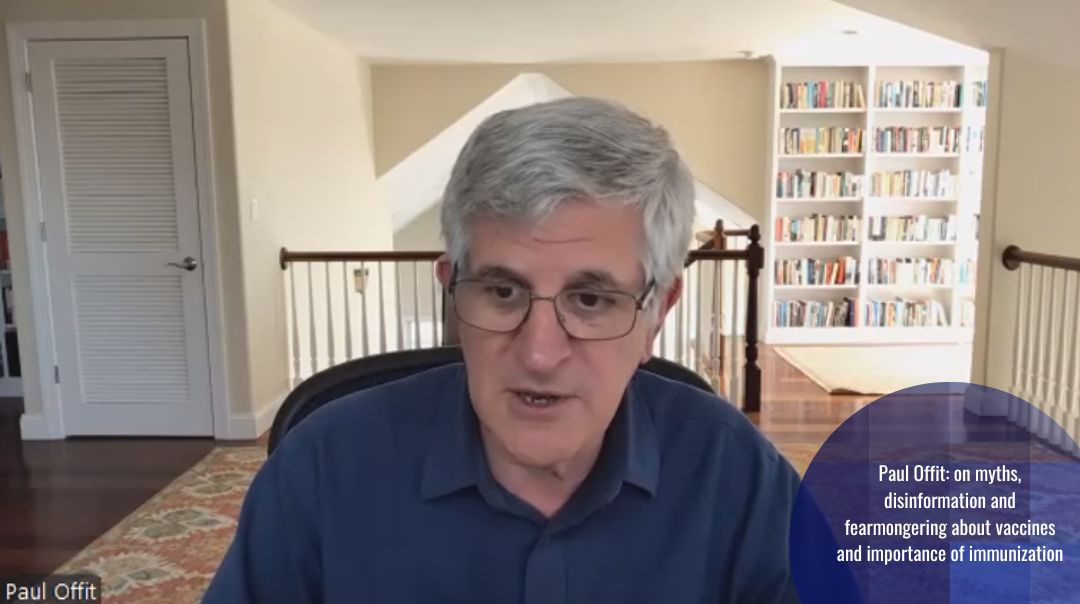
At a time when vaccine misinformation spreads faster than ever, conversations with credible experts are essential for understanding the facts. In this interview for Science speaks website, Jelena Kalinić speaks with Paul Offit, a pediatrician at Children's Hospital of Philadelphia and one of the world’s leading authorities in vaccinology. Offit openly discusses the most widespread misconceptions, parents’ fears, and how science responds to doubts — without oversimplifying, but without compromising on evidence.
Jelena Kalinić for Science Speaks: Mr Offit, what are the most destructive and most prevalent misinformation about vaccines that you encounter in your career?
Paul Offit: Well, it centers generally on vaccine safety. People fear that vaccines are causing a variety of different chronic diseases for a variety of different reasons, either because children are getting too many vaccines too soon, that that's somehow overwhelming or weakening or perturbing their immune systems, that there are ingredients in vaccines that are doing that, whether it was the thimerosal, this ethylmercury containing preservative that was in vaccines, but really is not in vaccines given to children anymore, not here, or that it was, you know, DNA fragments in the messenger RNA vaccines or other vaccines, I mean, any vaccine that's made from cells, like measles, mumps, rubella, varicella, anything that's made from cells could have DNA fragments, so you hear that.
I think the main things are, in this country, we have the so-called vaccine adverse events reporting system, where if you think there's a problem, you report it to the system. And I think the anti-vaccine people are very good at using that system. Abusing the system. So it's misnamed. I mean, frankly, it shouldn't be called the vaccine adverse events reporting system. It should be called the suspected vaccine adverse events reporting system, because I think people misunderstand that. And then package inserts. Package inserts will often include side effects to vaccines that have been reported following a vaccine, even if it occurs at the same level in the placebo group.
So that's confusing to people. So, you have two federal, you have the package insert, you have the VAERS system, both of which have a federal stamp to it, essentially, and both of which are misused. So, in many ways, we work against ourselves.
Well, but is there a way to convince not all the parents, you can never convince all the parents, but the majority of them that vaccines are safe and these ingredients are safe and well-studied, what we can do about that?
Paul Offit: Yes, I think we do. I mean, we do respond to people's questions. When people feared that the measles, mumps, rubella vaccine caused autism, we did studies. Same thing for thimerosal. Same thing for aluminum adjuvants. When people bring up those questions, to the credit of the academic community, to the credit of the medical and pediatric community, we do studies to answer those questions. And for the most part, people are reassured. They are. Most parents in this country give their children vaccines.
I would ask, because this is also one of the misconceptions and disinformation in our region, in whole Europe, actually, that if this disease, hepatitis B, is like, people usually think it's only sexually transmitted, which is not true, but it shouldn't be given to the newborns. Why do you, as a pediatrician, think that newborns should get that vaccine?
Paul Offit: So, the hepatitis B vaccine is a low-hanging fruit because it's given to newborns. So here your baby has just been born, and you're putting a needle into his arm or leg and injecting him with a biological agent that most people don't understand. So, it's not at all surprising people push back on the hepatitis B vaccine. In this country, we had a universal hepatitis B vaccine in 1991. At that time, there were roughly 16,000 cases of hepatitis B in children less than 10 years of age. Half of those children got it from their mothers, passing through a birth canal where the mother had been infected with hepatitis B, but the other half didn't. The other half, roughly 8,000 children less than 10 years of age, did not get it from their mother. They didn't get it because they were sex workers. They didn't get it because they were drug users. They got it because they had relatively casual contact with someone who had chronic hepatitis B, of whom there are millions of people in this country, and most people don't know it. Most people with chronic hepatitis B don't know. This is not AIDS virus. I mean, AIDS virus is not transmitted casually, but hepatitis B virus can be transmitted casually. And if you get a hepatitis B infection in your first year of life, you have a 90% chance of going on to develop cirrhosis or liver cancer. If you get it in the first five years of life, you have a 25% chance. So why would you ever take that risk by delaying the vaccine? Sooner you get it, the risk is bigger to get a cirrhosis.
It's a vulnerable time. Misinformation coming from the USA, sorry, from you guys, are affecting the whole world and my region of the world. So, Mr. Offit, you need to know that in Belgrade, in Serbia, last autumn, last fall, in September or November, I don't remember, we had a kid, a boy of six years old, who got tetanus. He survived. He survived, but it was hanging, really. And a two-month-old baby died, a whooping cough. And we had a few cases of, mortal cases of measles, because people didn't vaccinate their kids. Any message for people? Because people think that these diseases are extinct, it won't happen to their kids. Please, a message, very empathetic message to parents about this.
Paul Offit: A choice not to get a vaccine is not a risk-free choice. It's a choice to take a different and more serious risk. I think we all suffer from this myth of invulnerability, that it's never going to happen to us until it happens to us.
And if you talk to parents in these advocacy groups, like Families Fighting Flu, or Meningitis Angels, or National Meningitis Association, those parents all tell the same story. They had a child that was unvaccinated, who suffered and died from a vaccine-preventable disease, and they can't believe it happened to them. I think we never think it's going to happen to us because it's too awful to imagine that it would happen to us, but until it does.
And I think that's what I think people don't understand. They think that they're invulnerable to this stuff, and they're not, especially now, when things are getting worse. Certainly, in our country, things are getting worse.
So, you usually say that vaccines are the victim of their own success, because people don't see these diseases anymore, like diphtheria or something. I think that you already answered me about the auxiliary stuff in the vaccines, ingredients, about the safety kind of things in the first, actually in the first answer you did. But what we, as experts, science journalists, science communicators, can do better, more to counter disinformation and to reduce the effect of disinformation about vaccines? I think we have to be able to present the data that are reassuring.
So someone, for example, fears that the measles, mumps, rubella, or MMR vaccine causes autism. How would you know that? How would you answer the question? The way you would answer the question is you would look at children who did or didn't receive that vaccine to see whether or not there was a greater instance of autism in the vaccinated group. That study has been done over and over and over again in seven different countries on three different continents, involving hundreds of thousands of children.
It's reasonable to ask a question, but when it's answered, you have to be willing to accept that answer. And I think for people who don't accept that answer, they really move into the category away from being a vaccine skeptic, because it's reasonable to be skeptical of anything you put into your body to someone who basically is a conspiracy theorist. But this is the more that you cannot, this is the small percent of people who cannot be convinced they are completely a conspiracy theorist.
That's right. They think there's a conspiracy, they think you're part of that conspiracy, and therefore there is no convincing them. Just one more thing that I'm thinking, because right now I'm working on an article, about explanatory article, which wants to prove that there is, there are cases of autism between, amongst the unvaccinated kids and the other diseases. I mean, autoimmunological diseases, but because there is a trope that unvaccinated kids are healthier than the vaccinated, they have less autoimmunological diseases, neurological kind of consequences, or autism spectrum. But that's not true.
Paul Offit: No, that's not true. I know that in this country, there was a, there's a man named Aaron Siri, who presented a data at a congressional hearing that was run by a Senator from Wisconsin named Ron Johnson. And he presented this vaccinated versus unvaccinated study, which was never published. It wasn't published because the group that did it, this Henry Ford Clinic group that did it, found that the data were statistically flawed, methodologically flawed, and so it didn't answer the question.
It's hard to do that study. Remember, if you're going to do the study of people retrospectively who either got vaccinated or didn't get vaccinated, meaning didn't get vaccinated at all versus got fully vaccinated, you have to make sure that those two groups are alike in terms of all other aspects, socioeconomic background, medical background, healthcare-seeking behavior. And it, those two groups are generally very different in those areas.
They may, the unvaccinated group may be less likely to go to the doctor. Therefore, they would be less likely to be diagnosed with the disorder. The vaccinated group may be more likely to have illnesses that worried the parents so much so that they wanted to make sure that they were fully vaccinated. So you have to control for those things, and it's virtually impossible to do that. Also, it doesn't make biological sense. I mean, we are, from the moment we're born, exposed to trillions of bacteria, which induce an immune response.
We make a billion new immune cells every day to handle the onslaught from the environment. Vaccines are literally a drop in the ocean of what we encounter and manage every day.
I had one actually question that I want to ask you. That's about HPV vaccines. It was introduced here in Bosnia two years ago, which is very sad, but people are really, they are very against it because they still, the same problem as a hepatitis B vaccine, because they think that HPV can be transmitted only sexually. Why kids have to have these shots so young, does it make them more promiscuous?
Paul Offit: So, the human papillomavirus infections are common. About 80% of people, women and men who graduate from college will have been exposed to that virus. Every year in the United States, it causes roughly 30,000 cases of cancer in anal, genital, head and neck cancers. About two thirds of those cancers occur in girls and women and a third in boys.
It is the most common, frankly, only known cause of cervical cancer. We started to give the HPV vaccine in 2008 and have decreased the incidence of HPV cancers, cervical cancers by about 60%. So we have saved the lives of many women in this country because of that vaccine.
The notion that the HPV vaccine increases sexual promiscuity is a little silly. I mean, first of all, the HPV vaccine only prevents HPV infections and not, and there are, you know, 90 different serotypes. So there are many different, as you say, many different serotypes.
And this prevents, you know, nine of those serotypes, the most dangerous ones. Two, it doesn't prevent all sexually transmitted diseases. It doesn't prevent chlamydia, doesn't prevent gonorrhea, doesn't prevent syphilis. It only prevents most HPV infections. The notion that it increases sexual promiscuity is like saying, okay, now that I've gotten the tetanus vaccine, I can run across a bed of rusty nails without fear. I presume people don't think that either.