-
People who believe in conspiracy theories are more likely to exhibit traits such as a tendency toward pseudoscience, paranoia, schizotypy, and narcissism.
-
Self-esteem and Big Five personality traits are not significantly related to belief in conspiracy theories.
-
The results suggest that preventive measures and interventions should be targeted towards people with pronounced mentioned characteristics, in order to more efficiently reduce the influence of conspiracy theories on society.
I often hear the question of how someone can believe in conspiracy theories and pseudoscience and believe charlatans and very obscure prescriptions from alternative medicine. However, it is easier than you think. In fact, it takes effort and a lot of energy not to believe. But it is also true that someone with a higher education can believe in such things or even propagate them. Not once have we seen doctors of science, even medical sciences, doing this. But there is a set of personality traits that are more prone to conspiratorial thinking.
I once knew a person who gradually accepted one conspiracy theory after another. From anti-vaxxer attitudes, 9/11, fluoride poisoning, chemtrails, HAARP. The person had the feeling that he was being chased and wanted to go to uninhabited areas, without network coverage. In the end, he was found neglected, unwashed, diagnosed with vascular dementia, due to damage to blood vessels in the brain, which is a consequence of untreated high blood pressure, obesity and alcohol abuse. A person used to have a tendency to believe that he is better than others. This is just one example.
Paranoia, schizotypy as a basis for conspiracy theories
A 2022 study published in the Journal of Research in Personality is a comprehensive meta-analysis examining the relationship between personality and the tendency to believe in conspiracy theories. The authors analyzed 686 correlations from 127 independent samples, collected from research published from 1999 to 2020, to identify which personality traits most often correlate with belief in conspiracy theories. The analysis included a total of 12 personal characteristics, including religiosity, narcissism, tendency to pseudoscience, cognitive abilities, paranoid ideas, schizotypy, and traits from the “Big Five” model. The Big Five” is the most accepted personality model in psychology that describes personality through five basic dimensions: extraversion, agreeableness, conscientiousness, neuroticism and openness to experience.
The key conclusion of the study is that people who believe in pseudoscience, show signs of paranoia and schizotypy, have pronounced narcissism, religiosity or spirituality, and have lower cognitive abilities, are on average more likely to believe in conspiracy theories.
In contrast, factors such as self-esteem and personality traits from the “Big Five” model did not show a significant association with belief in conspiracies.
Interestingly, religiosity and the Big Five personality traits were among the most frequently studied variables, but they showed relatively weak associations with conspiratorial thinking. Pseudoscientific beliefs and paranoid ideation, on the other hand, showed consistent and strong associations with the tendency to believe in conspiracy theories.
The authors used Bayesian three-stage meta-analysis to account for variability between different studies and potential moderators. It was found that part of the heterogeneity of the results can be explained by the type of measurement – e.g. general conspiracy mentality versus belief in specific theories (like those related to 9/11 or COVID-19). No significant evidence of publication bias was found, which further strengthens the reliability of the results.
One of the important aspects of this study is its practical value: based on the identified personality traits, it is possible to more precisely define target groups for interventions aimed at preventing the harmful influence of conspiracy theories. Since conspiracies often lead to socially harmful behaviors (eg mistrust of vaccines, spreading hatred, ignoring scientific facts), developing personalized preventive measures becomes of particular importance.
Limitations of the study include the fact that the correlational approaches used cannot be used to infer causal relationships. Also, it is possible that some relationships between variables were not observed because they are not linear. Nevertheless, this research offers the most comprehensive overview to date of the psychological characteristics that predispose people to believe in conspiracy theories.
However, as emphasized by Greenburgh and Raihani, 2022, paranoia and belief in conspiracy theories are related, but different concepts — paranoia is mainly focused on personal, specific fears, while conspiracy theories are often collective and involve the perception of common harm. It is not true that all those who believe in conspiracy theories are paranoid, nor that all paranoid people are inclined to believe in conspiracies. Belief in conspiracy theories is influenced by numerous personal, social and political factors, not only psychological disorders, which should be taken into account in order not to stigmatize people with mental problems.
Echo chambers, the dark triad and tribalism as factors of predisposition to conspiracy theories
This is not all – users of social networks often choose information that confirms their previous beliefs and enter the so-called echo chambers – closed, polarized communities of like-minded people. A 2016 study published in Computers in Human Behavior also showed how longer stays in echo chambers can slightly shape the psychological profile of users, which has important implications for combating disinformation. Another study from 20216 published in Scientific reports showed how social networks can accelerate the creation of communities that believe in conspiracy theories, out of the echo chamber mechanism.
Psychological profiling of users is a double-edged sword – it's easy to imagine that people exposed to disinformation conspiracy content will be exposed to science – but how hard-headed are their beliefs. We know from past experience that it is very difficult to convince them otherwise. On the other hand, if we expose a person who is in favor of science, but can be manipulated, to disinformation content, what is the probability that he will switch to the “dark side”?
Let's not forget that the worst conspiracy theories contain elements of truth, and that the temptation to pseudoscience often starts with stories about health, keeping the body in shape, and physics. For example, the story of controlling the world can be wrapped in the story that Africa can provide the whole world with energy, only someone doesn't want it, or that there is superconductivity at room temperature, but it is being hidden.
It's interesting how people who hold these beliefs have a need to be different, not to be mainstream, but in reality they are looking for a community of like-minded people.
A 2023 study published in Expert Systems and Applications shows that individuals with the dark triad, who have Machiavellian characteristics, are more likely to spread and consume fake news and misinformation.
All this suggests that belief in pseudoscience, tendency to paranoia, schizotypal traits, Machiavellianism, tendency to manipulative behavior, tendency to tribalism, staying in echo-chambers on social networks without exposure to the content of opposing thoughts. narcissism, religiosity and lower cognitive abilities are key psychological factors associated with conspiratorial thinking. These insights can help create more effective educational and communication strategies to combat misinformation and the harmful influence of conspiracies in modern society. But all these studies have proved unsuccessful to date to serve as a basis for creating strategies to combat disinformation and inoculate citizens against them, as we see. This does not mean that they are not valid – but that more should be invested in activities that directly contribute to risk reduction and increase resistance to misinformation and conspiracy theories. So that these are not individual efforts in a sea of influencer content, bad educational policies and strategies that are sitting in some closet.
What is also a problem is that there are still no adequate actions in the world to protect mental health, timely diagnostics, or awareness of the wider impact of such disorders on society. People with these disorders often have strong charisma, a messianic complex, are good speakers, are persuasive, some, not all, can be good manipulators. They often have very popular social media channels and from marginalized weirdos, they become charismatic preachers, who (and whose followers) are difficult to confront with facts.
References:
- Stasielowicz, L. (2022). Who believes in conspiracy theories? A meta- analysis on personality correlates. Journal of Research in Personality, 98, 1–15. https://doi.org/10.1016/j.jrp.2022.104229
- Anna Greenburgh, Nichola J. Raihani, Paranoia and conspiracy thinking, Current Opinion in Psychology , Volume 47,2022,
101362, ISSN 2352-250X, https://doi.org/10.1016/j.copsyc.2022.101362. - Song X, Guo S, Gao Y. Personality traits and their influence on Echo chamber formation in social media: a comparative study of Twitter and Weibo . Front Psychol . 2024 Feb 8;15:1323117. doi: 10.3389/fpsyg.2024.1323117. PMID: 38390405; PMCID: PMC10881801.
- Del Vicario, M., Vivaldo, G., Bessi, A. et al. Echo Chambers: Emotional Contagion and Group Polarization on Facebook. Sci Rep 6 , 37825 (2016). https://doi.org/10.1038/srep37825
- Srinivas PYKL, Amitava Das, Viswanath Pulabaigari, Fake spreader is narcissist; Real spreader is Machiavellian prediction of fake news diffusion using psycho-sociological facets, Expert Systems with Applications, Volume 207, 2022, 117952, ISSN 0957-4174,
https://doi.org/10.1016/j.eswa.2022.117952.
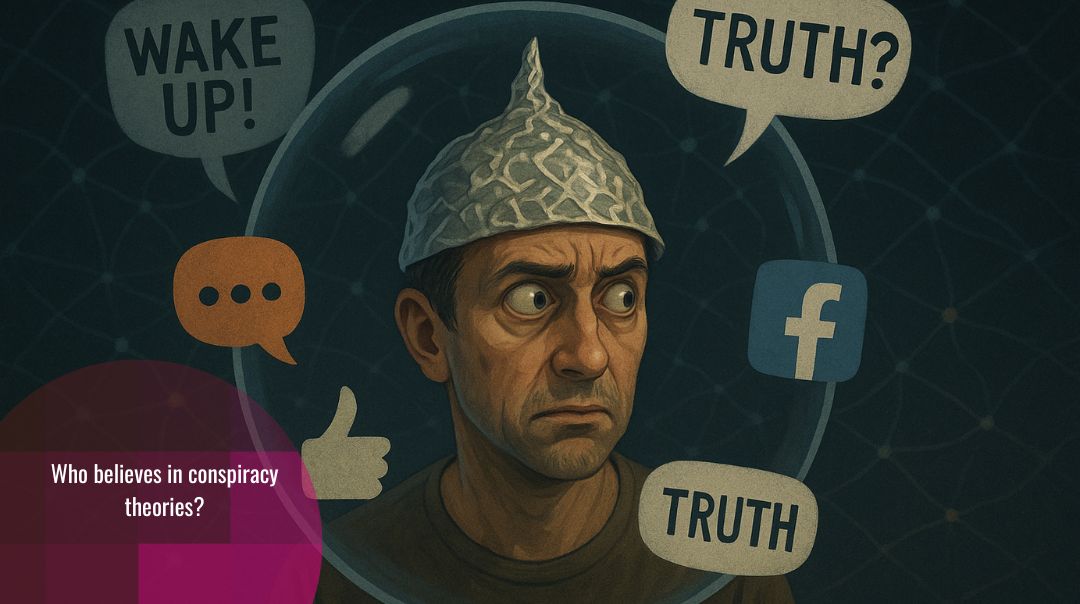
Cover illustration created via ChatGPT
Jelena Kalinić, MA in comparative literature and graduate biologist, science journalist and science communicator, has a WHO infodemic manager certificate and Health metrics Study design & Evidence based medicine training. Winner of the 2020 EurekaAlert (AAAS) Fellowship for Science Journalists. Short-runner, second place in the selection for European Science journalist of the year for 2022.