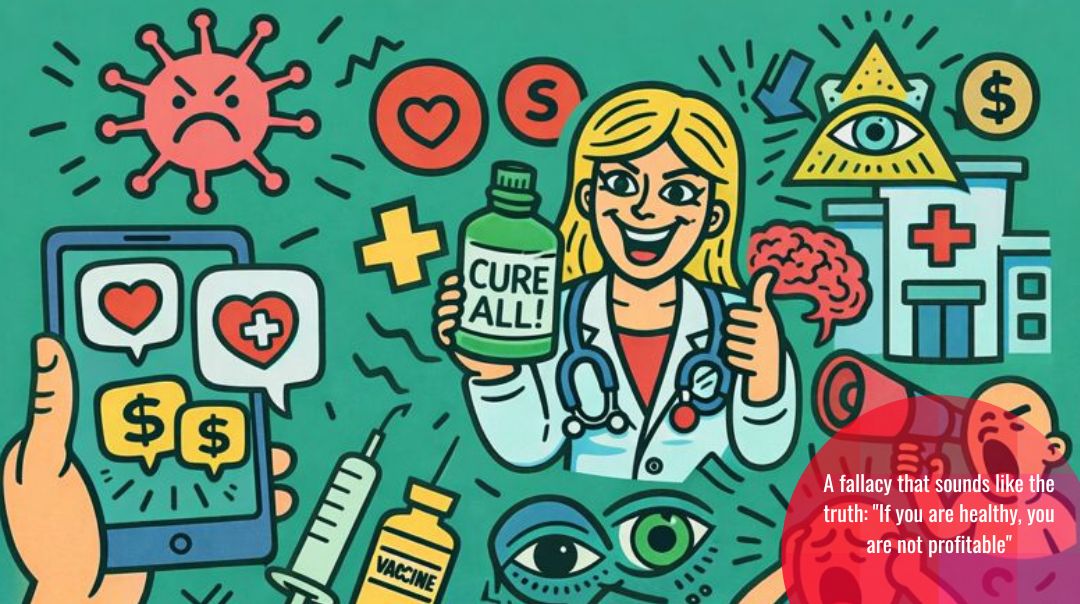
There is one sentence that occupies a special place on social networks, it sounds powerful, rebellious and “awakened”, empowering: “The system is not interested in you being healthy, because if you are healthy – you are not profitable.” That is precisely why it is so common among pseudoscience alternative medicine charlatans, self-proclaimed gurus and sellers of miracle solutions. Its strength lies not in accuracy, but in emotional impact. And when emotions are involved, logic often falls out of the game.
The Industry of Doubt: Why They Tell You That No One Has Your Health in Their Interest
Always keep in mind – when something affects you emotionally, scares you and causes anger, distrust, or threat, you react with old evolutionary mechanisms of the brain. From being angry with your partner or being rejected by your girlfriend or boyfriend, to feeling threatened for your health or the health of your children.
The first problem with this claim is the unspecified enemy. Who is the “system”? Doctors? Pharmaceutical companies? Nurses? Public hospitals? Scientists who have been studying diseases for decades? Insurance companies, state and private? Private healthcare? When concepts are deliberately blurred, the claim becomes unverifiable – and anything that is unverifiable is easily presented as a “hidden truth”.
Another logical error is a false dilemma: either you are healthy and no one makes money, or you are sick and everyone profits. So, the one who serves you this sentence is deliberately falsely showing you only two options, while in reality, there are usually more nuances and many different situations and possibilities. In reality, chronic, neglected and advanced diseases are the biggest “cost” for healthcare systems. Prevention – vaccination, early screening, control of blood pressure, sugar, cancer – is cheaper, more efficient and more profitable for society in the long term. If the “system” really wanted sick people, investing in prevention would be pointless. And it is precisely in prevention that billions are invested.
Systematic examinations of children, where some defects and difficulties are detected early, from flat soles to undescended testicles in boys. Systematic examinations of students and workers in the public or private health sector. Additional health insurance option that offers biochemical, ultrasound examination, internist examination. Gynecological examinations and breast examinations – all of these are ways to detect problems and diseases at a stage when it is cheaper to treat them and when the chances of cure are higher. Of course, these examinations cost money, but they are still cheaper than treating the disease in an advanced stage.
Vaccines against the human papillomavirus significantly reduce the risk of developing precancerous and cancerous changes on the cervix or on some other organs (throat, genital-anal region). And they are cheaper than treating these changes. The vaccine against tetanus is cheaper than the very difficult treatment of this disease. The vaccine against polio is cheaper than keeping alive a patient who has contracted this disease. Vaccines against whooping cough and flu during pregnancy reduce the risk of illness for mother and child in the first months after birth, and reduce the risk of complications in pregnancy, and significantly reduce the risk of dementia and prolong the life of older people.
The Myth of a System That Wants Sick People – And Who Really Makes Money From It
The third problem is the contradiction in practice. The people who most often utter this sentence simultaneously sell supplements, “detox” cures, bioenergy, unproven quantum medicine, and advice without any proof. If the disease is profit, then they – paradoxically – are direct participants in that profit. The only difference is that they don't call their interest “business”, but “the truth that the system hides”.
There is also a misunderstanding of medicine. Medicine is not monolithic, but a huge, often imperfect, but self-critical system that is constantly changing based on evidence. Diseases that were once fatal are now curable or controllable. That's no accident. It is the result of research, regulation, clinical studies and public health.
And yes – the degree of investment in health care also depends on the state's wealth. Screenings for changes in the cervix, colon and other examinations should be part of the offer of the public health system. However, at the same time, we are increasingly witnessing the lack of medicines for oncology patients and various systemic problems. All this is fertile ground for attacking health systems and spreading mistrust.
And that is exactly the goal: this is a claim that destroys trust. When people believe that no one has an interest in them being healthy, they stop trusting doctors, refuse therapies, refuse vaccines, delay diagnoses and become easy prey for those who offer simple solutions to complex problems. This is not “getting rid of the system” – it is an increase in risk.
Distrust of Healthcare Has Become Perfect Marketing. Inoculation Against Manipulation Is Extremely Important
Inoculation against this idea does not require ridicule, but rather the exposure of the mechanism. The next time you hear this sentence, ask yourself: who exactly benefits from me not believing the evidence? And why is the “truth” always offered to me by someone who is selling something?
How much do these supplements and online coaching from a guru cost, some online training? These are often people who have not completed their education in the field of life science. And yes – you have to be careful here, because even people with university degrees in medicine and pharmacy, for example, can sink into the waters of alternative medicine and unproven practices or be agents of some overpriced supplements. A red flag is definitely offering quick solutions. Using words like biohacking, feminine energy, transformation, liberation – could be a signal that should not be ignored. If someone offers you shortcuts, a quick change, something is wrong. And real experts often speak with caution, overconfidence is a sign of marketing and not knowledge.
Healthcare is not a perfect system. But the idea that disease is the goal, not the problem, is not a brave truth. It's a marketing slogan – wrapped in a conspiracy theory.