After the sudden closure of the Northwestern clinic, hundreds of patients were left in limbo about the fate of their embryos and other biological material. Many faced fear, helplessness, and a sense of losing control over something that represented their hope for parenthood.
For many couples struggling with infertility, the decision to begin IVF represents years of hope, sacrifice and emotional exhaustion. For them, frozen embryos and other stored biological material are not just medical samples – they represent the possibility of becoming parents one day. This is precisely why the closing of the Northwestern Medical Center Polyclinic, formerly New Life BiH, caused a deep sense of uncertainty among hundreds of patients.
The Sudden Closure of the Clinic Exposes a Systemic Vacuum in the Oversight of Biomedically Stored Embryos
The clinic was closed in October 2025, without prior notice to users. Since then, patients can no longer access their biological material or retrieve it and move it to another institution. Eight months later, embryos and other samples are still behind the locked doors of a facility whose owners have disappeared from public view.
However, this was not the first problem with the clinic. Most of the users were patients of the New Life Clinic and had already started some procedures there. And then in 2024, without any information to the patients, without any announcement, that clinic became the property of Northwestern Medical Center.
It is an institution that had a contract with the Institute of Health Insurance and Reinsurance of the Federation of Bosnia and Herzegovina for the implementation of biomedically assisted insemination procedures. However, after its closure, numerous questions were raised about who is responsible for keeping biological material and protecting the rights of patients, as well as questions related to the general condition of that biological material.
In video messages they posted, clinic users describe feelings of abandonment and disbelief. They say the clinic's doors were simply locked one day, with no explanation and no way to get information about the fate of what they consider their last chance at parenthood.
Patients Learn Fragmented and Delayed Information, While Concerns About Biological Material Grow
The containers containing the biological materials remained in the premises of the Core Business Center, where the North Western Medical Center clinic is closed, at Meša Selimović Boulevard 17A in Sarajevo, which are the property of the company A2D Core.
“I personally found out about the problem in early November. The problem arose when I called the clinic several times to schedule a consultation with them. The landline was informed that the line was out of service, and the mobile phone was constantly unavailable. I looked for their website, saw that there was no news, there was no news on their Facebook profile, there had been no posts for a long time, I went there, saw that the door was closed, there was no sign, it was locked, nothing anywhere. That's when I panicked,” said Alma Ljubica Kovačević, one of the users and patients of the Northwestern clinic.
Then she calls the Cantonal Ministry of Health, where they tell her to call the Federal Ministry of Health.
“I called the Federal Ministry of Health, the assistant minister answered and said that he hopes to solve it in one of these days, there is no problem, so that we don't have to worry. However, that solution has not happened even to this day,” continued Alma.
“We, as patients, are not at all sure that our samples that we left there have remained there 100%, that is, that they are still there. Why? Because of the inaction of the institutions in the past 8 and a half months and the unavailability of our materials because we still cannot get them available, I express my open confusion that our embryos and biological materials could have been misused even before that, that someone had unauthorized disposal of them in the sense that he could have taken them across the border to sell them on the black market as donated embryos, gametes, etc.”, she explained.

Alma Ljubica Kovačević
About 500 Potential Babies – Embryos Are at Risk
Of particular concern is the fact that the clinic has around 500 frozen embryos, as well as gamete samples. Their long-term preservation depends on continuous professional supervision and maintenance of liquid nitrogen tanks. The patients warn that the person who performed this work until now has already retired, while, according to their knowledge, no institution has appointed an expert who would officially take responsibility for the further care of the embryos.
She adds that what worries them the most is precisely the absence of a clear institutional response. He states that, according to the information at their disposal, the Ministry of Health of the Federation of Bosnia and Herzegovina, as well as other competent institutions, have not yet designated a person who would be responsible for monitoring the stored biological material.
“The Federal Ministry of Health, as the competent ministry for the issue of biomedical assisted fertilization, which is assigned exclusively to them by law, since the closing of the clinic and until today, for 8 months, has never appointed a person who would be obliged to take care of the embryos and gametes that were frozen and left on the premises of the clinic, and that Ministry, according to the Law, has a Commission for the application of procedures of biomedical assisted fertilization, which until now has not announced itself at all. The recently published report of the Office for the audit of institutions in FBiH stated that” a new Commission for the application of biomedically assisted fertilization procedures has not been appointed in accordance with the provisions of Article 19 of the Act on Infertility Treatment with Biomedically Assisted Fertilization“, says Alma.
In the “Ad hoc” decision on the appointment of the Commission signed by Minister Nediljko Rimac dated 13.11. last year and which appoints the Commission for monitoring the transfer of materials from Sarajevo to Zenica, it was ordered that the chief federal health inspector should ensure sufficient amounts of nitrogen.
“So nowhere is it ordered that the inspector should add liquid nitrogen to the tanks. Given that the Ministry did not appoint a person to do so, the federal health inspector decided to add nitrogen in order to work in the public interest and to keep the materials alive“, said Alma.
However, the care of embryos and gametes is not limited only to the application of liquid nitrogen in order to achieve an adequate temperature.
“There is a whole chapter of the law on the way embryos and gametes are maintained in containers. Taking care of these samples is not just adding nitrogen, it's also constant daily temperature control and other actions, but we don't have access and we don't have the ability to monitor it at all“, Alma pointed out.
“Embryos and other reproductive biological materials are stored in liquid nitrogen at a temperature of -196°C, with strictly defined procedures and continuous monitoring. Each sample must be clearly labeled and there must be complete traceability of its storage. However, patients today do not have an answer to the most important question, whether their embryos were properly stored, whether they are still vital and whether they will ever be able to be used“, Prof. Dr. Fatima Gavrankapetanović – Smailbegović, specialist in gynecology and obstetrics, representative of the SBiH in the Sarajevo Canton Assembly and delegate in the House of Peoples of the Federation of BiH.

Dr. Fatima Gavrankapetanović-Smailbegović
Fearing that the embryos might be at risk or permanently lost, the patients reported the case to the relevant institutions. However, months pass, and they are still waiting for an answer to the most important question – when will they be able to dispose of their own biological material again and continue the path to parenthood that was suddenly interrupted by the clinic's closure.
Protests, Fear, Anxiety of Patients and Lack of Response and Empathy From Institutions
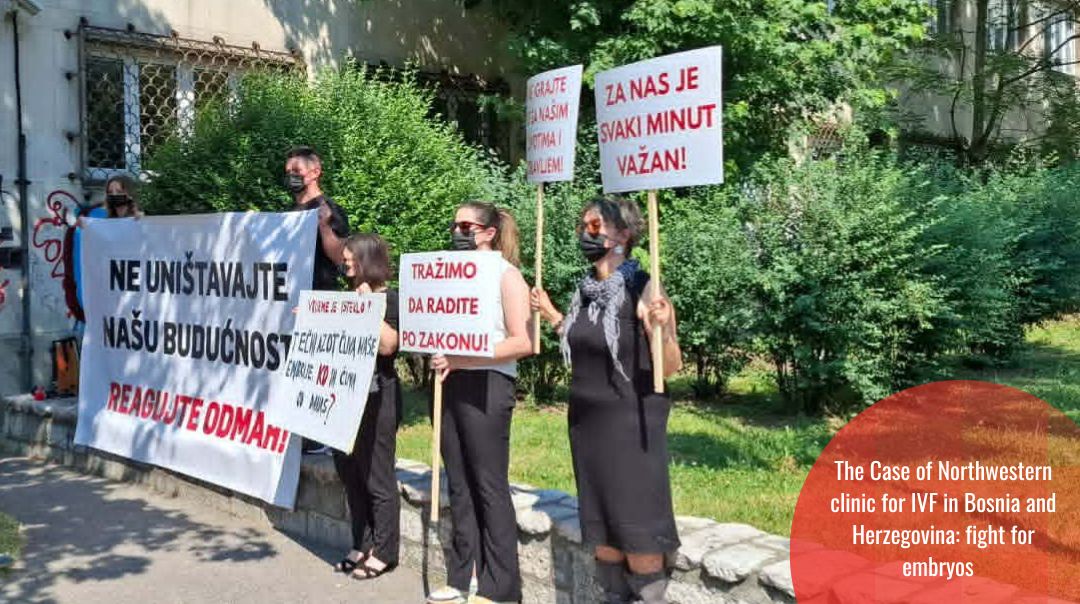
From the clinic's closure until June 2026, distressed and panicked patients repeatedly tried to contact the Federal Ministry of Health on various phone numbers regarding this issue, and organized protests in January and again in June 2026. Nauka spori also contacted the Federal Ministry of Health via email, but as of the publication of this text, we have not received any response.
“We don't know what to say about this behavior of the Ministry, which acts as if it doesn't really want to preserve our embryos“, said Alma.
The human rights ombudsman institution of Bosnia and Herzegovina issued Recommendation No. P-195/26 of June 2, 2026, addressed to the Federal Ministry of Health, following a complaint by patients of the Northwestern Medical Center IVF Polyclinic in Sarajevo due to the impossibility of accessing their stored biological material. In the recommendation, the Ministry is requested to immediately establish cooperation with the Ombudsman Institution, in accordance with the Law on the Ombudsman for Human Rights of BiH, and submit the requested statement. In accordance with the law, the recommendation was also delivered to the complainants.
On June 18, the Municipal Court in Sarajevo issued a Decision on the determination of a temporary security measure ordering the Federal Ministry of Health to continuously store the material in the prescribed cryocells, ensure the necessary quantities of nitrogen and supply it, and appoint an expert to carry out these actions. The decision also prohibits the Federal Ministry of Health and the Northwestern Clinic from moving, giving to third parties, thawing, damaging or disposing of the patients’ biological material in any way.
According to the Law on Treatment of Infertility by Biomedically Assisted Reproduction, published in the Official Gazette of the Federation of Bosnia and Herzegovina, Year XXV – Number 59, from 2018, it explains the role of the Commission for the Application of Biomedically Assisted Reproduction Procedures. The Commission is an expert and advisory body within the Federal Ministry of Health appointed by the Federal Minister for a four-year term, and consists of experts in the fields of gynecology, pediatrics, genetics, biology, psychiatry or psychology, law, a representative of the Ministry and a representative of a patient association.
According to the Report on the Financial Audit of the Federal Ministry of Health for the year 2025, the audit concluded that a new Commission for the application of biomedically assisted fertilization procedures was not appointed in accordance with the provisions of Article 19 of the Act on Infertility Treatment with Biomedically Assisted Fertilization. A recommendation was issued to appoint a commission for the application of biomedically assisted fertilization procedures in accordance with the Law on Infertility Treatment with Biomedically Assisted Fertilization. By the time this article was published, the Ministry had not done so.
Transparency International (TI) in BiH also got involved in the case.
“The case of the closure of the IVF clinic in Sarajevo, which left dozens of patients without access to their own reproductive material and embryos, represents a gross attack on the basic rights and dignity of patients. For eight months, citizens have been facing a complete wall of silence and the shifting of responsibilities between competent institutions, while their rights are directly threatened“, said Transparency International.
TI adds that the FBiH Law on Infertility Treatment with Biomedically Assisted Fertilization clearly stipulates the obligation to form a commission that decides on the transfer of material to another institution.
“Despite this, the Federal Ministry of Health ignored all patient inquiries, and then the official requests, emergencies and appeals of Transparency International in BiH (TI BiH). This kind of behavior – the ‘silence of the administration’ at times when it comes to such a sensitive and biologically critical issue – is absolutely unacceptable“, emphasized Transparency International.
“The fact that TI BiH had to initiate an administrative dispute before the Cantonal Court in Sarajevo against the Federal Ministry of Health shows the state of institutional responsibility. Patients must not be victims of poor regulatory oversight of private clinics, nor the dysfunctionality of the system. Controls in this area must become more rigorous so that situations like this do not occur“, TI added in an email that was a response to an inquiry by Science Speaks.
After the protest of injured patients, on June 26, 2026, the Federal Ministry of Health announced on its official website.
In that statement, the Ministry stated that “The Federal Ministry of Health is not a health institution or a legal entity authorized to purchase, store or handle medical gases. Since liquid nitrogen is a medical gas that is considered a medicine under applicable regulations, its purchase and use can only be carried out by authorized health institutions and legal entities that meet the requirements prescribed by law. Therefore, the Ministry cannot legally purchase, secure or top up liquid nitrogen.“
The Ministry stated that they cannot approve individual transfers of biological material from an unauthorized to an authorized health facility, because there is no legal basis for such a procedure. The current regulations provide that the transfer can be carried out exclusively between authorized health institutions, through a procedure prescribed by law and with the fulfillment of all prescribed conditions, and say that PZU “Northwestern Medical Center” Sarajevo does not and has never had verification from the Federal Ministry of Health for the implementation of biomedically assisted insemination procedures.
This means that the Ministry will not implement the Order of the Municipal Court and that they consider the Court's Decision to be illegal and unenforceable.
All this has an impact on the psychophysical health of damaged patients who complain of anxiety, are exposed to great stress and fear.
A Crisis That Raises Questions Not Only About One Clinic, but Also About the Functionality of Regulatory Oversight and Law Enforcement
We remind you that this is happening half a year after the Federal Ministry of Health published a statement in December 2025 that “Zenica Cantonal Hospital refuses to take over embryos and biological material from the private polyclinic Northwestern Medical Center, even though the Federal Administration for Inspection Affairs passed a decision ordering that institution to urgently take over and temporarily dispose of embryos and biological material.”
The Federal Ministry of Health then stated that it immediately notified the competent prosecutor's office, the Federal Administration for Inspection Affairs and KB Zenica and requested the immediate implementation of the inspection decision in order to protect embryos and other biological material. The Ministry then announced that it would continue to take measures under its jurisdiction and regularly inform the public about further steps. KB Zenica did not carry out the order of the Federal Inspection, referring to the absence of guidelines. There is a decision of the court in Sarajevo on the temporary postponement of the transfer of the material because the Ministry of Health did not give instructions to the Cantonal Hospital in Zenica on how to transfer the samples. The Zenica hospital does not have facilities, containers or vehicles for transport.
There are a few things to think about in the case of Northwestern Clinic. Embryos and other biological material could have been threatened in other ways – what if there had been a power outage, a flood, an earthquake, a shortage of liquid nitrogen or any other reason, regardless of whether it was private clinics or public health institutions? This means that private clinics do not have a risk analysis, nor do they have the ability to communicate in a crisis, even in the event of business shutdown. However, this means that the state institutions are not capable of adequately and quickly reacting, crisis communication and reducing the risk and damage caused in such cases, they do not have full control or risk analysis for such and similar cases. It also means that there is no insurance and reinsurance system for biological material and that the country is vulnerable to such challenges.
This is not the first time that human biological material in Bosnia and Herzegovina has been endangered and left to chance. Nauka spoji already wrote about a similar scandal in 2022 when the CryoSave clinic for storing umbilical cord stem cells was closed, leaving people unaware of what was happening to the biological material they had paid dearly to preserve. This should have been a lesson to state institutions, but unfortunately it was not.
“All of this greatly affects the mental and physical health of the patients whose materials remained trapped because the fates of hundreds of families are at stake. Some marriages are already in crisis and on the verge of divorce due to months of agony“, added Alma Ljubica Kovačević.
“We are in severe uncertainty for a full 8 months. Life in uncertainty for such a sensitive and important matter in life means a life in tension and mental madness. We don't even know how we sleep, nor what we do, our private lives don't work, our work suffers, so we are absolutely in a vacuum with no way out for a full eight months, and nothing happens or gets resolved. We literally just hope for a solution“, says Amela Tandir, another of the damaged patients in this case.
This also means that state institutions do not and cannot show empathy, and this is about someone's potential children. So, we are talking about 500 embryos, in an era where women are constantly being encouraged to give birth due to the decline in the birth rate. This is an unprecedented bioethical tragedy in these areas. This behavior of public institutions undermines the already shaken trust in health institutions, which can be reflected in a number of public health measures.
“What happened in the in vitro fertilization polyclinic is unthinkable in a civilized society and a legal state. The fact that around 500 embryos and other biological material remained trapped, and that the patients did not have any information about their fate for months, is deeply disturbing and humiliating. Behind each of these embryos is a difficult life story, years of struggle with infertility, numerous sacrifices, an emotional and financial burden. Their only wish was to become parents. They all put their trust in our health system, and in return they were left in uncertainty“, Dr. Fatima Gavrankapetanović-Smailbegović told Nauka govori.
Embryos and other reproductive biological material are stored in liquid nitrogen at a temperature of -196°C, with strictly defined procedures and continuous monitoring. Each sample must be clearly labeled and there must be full traceability of its storage. However, patients today do not have an answer to the most important question, whether their embryos have been properly preserved, whether they are still vital and whether they will ever be able to be used.
In the case of the Northwestern clinic and embryos, the fact that FBiH is not prepared for such crisis situations is exposed, the system is vulnerable, and this is a warning that something like this should never happen again. Although the law on medically assisted fertilization exists, in this case it was not implemented in a way that would protect biological material and patients’ rights from damage, destruction and abuse.
“One of the conditions for the clinic to get a license to work is that it has a contract with a backup clinic, with another clinic from which it will take over the continuation of treatment in case of emergency circumstances in one clinic. However, we know from documents and research media that Northwestern did not renew the contract for some time before the closure because they did not even submit an application for license renewal“, said Alma Ljubica Kovačević, and the Ministry also stated this on its website in a statement that “NW clinic did not have a license to work“.
Also, this reduces trust in the private clinic sector, which partially threatens the work of other clinics for medically assisted fertilization, as well as private clinics, polyclinics and hospitals in general – this is a dark stain on the face of private health institutions. Because, if the Ministry monitors the work of all other clinics of this type and if, after the expiration of the commission's mandate, that regulatory body – Povjerenstvo, was not formed again, the basic commission that should take care of all these things, then a logical question arises as to how the patients of other clinics could experience a better fate if a similar problem occurs.
Behind this case is not only an administrative or legal dispute, but also hundreds of people who tried medically to realize one of the most basic life rights – the possibility of becoming parents. At its core, this is a bioethical scandal. While institutions determine responsibility and conduct proceedings, the embryos and other biological material of these people remain unavailable, at the mercy of time, and time further deepens the uncertainty. Therefore, patients are not looking for preferential treatment, but for the protection of their rights and an urgent solution that will ensure that their biological material is safe and that they will be able to continue treatment.
“This is a serious institutional failure that directly affects human destinies. The state was obliged to ensure the continuity of work or the urgent transfer of embryos and biological material to an institution that meets all professional and legal requirements. If such an institution does not exist in our country, which is unfortunate, then the embryos should have been transferred under strictly controlled conditions to polyclinics outside our country”, believes Dr. Fatima Gavrankapetanović -Smailbegović.
Dr. Gavrankapetanović-Smailbegović points out that this kind of playing with the most sensitive issues of life is completely unacceptable.
“For many of these couples, frozen embryos are the last chance to become parents. Therefore, the competent institutions must urgently provide clear answers, determine the responsibility of all those who led to this situation, and take all measures to protect biological material and the rights of patients. We are not talking about numbers here, but about human destinies. Each of these embryos represents the hope of a family that is still waiting for its child”, concludes Dr. Fatima Gavrankapetanović-Smailbegović.
Jelena Kalinić, graduate biologist, MA in comparative literature, scitech, health journalist, journalist and science communicator, has a WHO infodemic manager certificate and Health metrics Study design & Evidence based medicine training. Second place in the selection for European Science journalist of the year for 2022. Internews Health Journalism Ambassador for 2022. BIRN Fellowship- Digital/AI rights. Especially interested in healthcare, the relationship between science, democracy and society and the impact of technology such as AI on society and AI ethics. In 2015, she founded the scientific blog Quantum of Science, which was rebranded as Science Speaks in 2023. The founder and editor and main author of Nauka govori and the host and editor of the Nauka govori podcast and Instagram and FB profile Nauka govori. In 2018, she also founded a website for information about vaccines, Vakcine.ba.