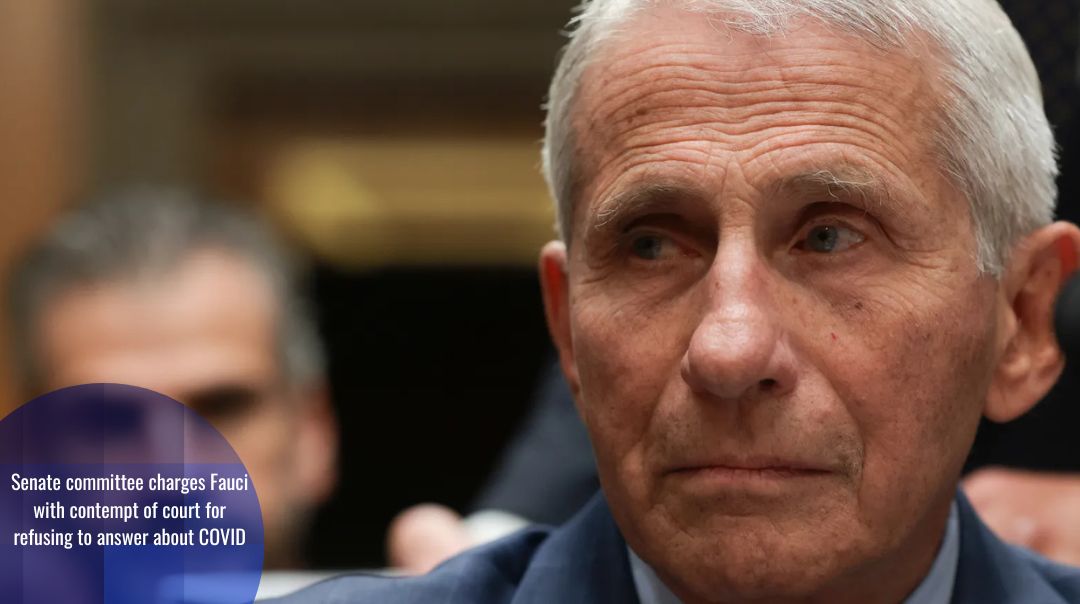
A Senate committee voted Thursday, August 6, 2026, to hold Dr. Anthony S. Fauci, the scientist who led the US response to the Covid crisis, in contempt of Congress for refusing to answer questions during a hearing in early August 2026. Fauci invoked his constitutional right under the Fifth Amendment to remain silent, refusing to answer one question during a three-hour hearing of the Senate Homeland Security Committee.
“The only instance of unconstitutionality that occurred during Dr. Anthony Fauci's Senate hearings was unconstitutionality by committee members. Republican members of the committee questioning Fauci about his leadership during the Covid-19 pandemic voted Thursday to hold the former top health official in contempt of Congress for invoking his Fifth Amendment right against self-incrimination. Although the full Senate is unlikely to muster the 60 votes needed to overcome a filibuster and passing the resolution, the committee's vote is a cynical tactic of portraying Fauci as a villain without any legal basis ,” Barbara McQuade, a professor at the University of Michigan Law School, told Bloomberg opinion.
What is it about?
The essence of the Fauci case lies in the collision of two different legal protections: presidential pardons and the right not to testify against oneself .
This is an unprecedented case in the American legal system. So, a US Senate committee voted to hold Dr. Anthony Fauci in contempt of Congress for refusing to answer questions during hearings about his role in the US response to the COVID-19 pandemic. Fauci invoked the Fifth Amendment to the US Constitution, which protects a person from being forced to testify against himself.
The problem, however, is that Fauci received a preventive and unconditional pardon in January 2025 from then-President Joe Biden. The pardon covers his federal offenses from 2014 to January 19, 2025. Republicans argue that this leaves him no longer a reason to invoke the Fifth Amendment: if he is protected from federal prosecution, the argument is that his answers cannot be used against him.
But the legal situation, as the NYT shows , is not so simple. Jurisprudence on the relationship between presidential pardons and the right to remain silent is very limited. A pardon protects only from federal prosecution , while the Fifth Amendment can protect a person from self-incrimination that could lead to state criminal proceedings . That's especially important because Florida, Alabama and Louisiana have announced their own investigations into Fauci.
The board can now refer the case to federal prosecutors. They can request a grand jury investigation and possibly an indictment for criminal contempt of Congress. It is a misdemeanor punishable by up to one year in prison and a fine.
The key question, however, will not only be whether Fauci refused to give Congress answers, but whether he had a constitutional right to do so . If the court finds that his Fifth Amendment invocation was lawful, the proceedings could be halted.
On the other hand, the decision that a person granted a presidential pardon can still be compelled to testify could create a very significant precedent for the relationship between the presidential power of pardon and the constitutional right to remain silent.
The consequences of the Fauci case
The ramifications could be much broader than the Fauci case itself. It is important, however, to distinguish what is already legal consequence from what could be precedent if the courts accept the arguments against Fauci . The legal consequences of the interpretation of the Fifth Amendment and the pardoning of the president in the USA are certainly for future cases, because American law is based on Anglo-Saxon law (common law). Precedents play a big role in this law and court decisions from earlier cases can be binding for courts in later, similar cases (stare decisis ).
If the court sides with Fauci, it will uphold a broad understanding of the Fifth Amendment: a person does not have to help the state build a case against him just because there is a presidential pardon for a certain period and for certain acts.
If the court sides with Congress, the consequences could be much greater. It would set a precedent that a pardon could significantly narrow the scope of invoking the Fifth Amendment. That could change the way Congress conducts investigations and how witnesses are assessed for their risk of testifying.
Congressional decisions in the Fauci case have implications for both science and public health. If scientists who make decisions during a crisis can be called before Congress years later as potential criminal actors, this can produce a chilling effect. Scientists and public health experts may be more cautious in making recommendations during future outbreaks, especially when decisions are unpopular or politically controversial.
Globally, this will give a wind at the back of those who spread misinformation and opponents of epidemiological measures. If and when a new epidemic/pandemic occurs, it will have fatal consequences, much worse than Covid, which was supposed to be a lesson in practicing respect for measures, solidarity, empathy and organization, and an exercise in detecting the weaknesses of health systems.
Political responsibility, science, facts and evidence
The problem arises when political responsibility begins to be equated with a scientific error or a different scientific opinion. Science advances precisely because hypotheses can be proven wrong. Misjudgment during an uncertain pandemic is not automatically a crime. At the Science Talk, there was already talk about the evidence that epidemiological measures such as wearing masks and quarantine are effective, but for a limited period, that is, they are good to give time for the creation of vaccines and/or medicines. In the long run, lockdowns also show their problematic effect, especially on mental health, on children's education, but also on the economy.
However, while talking about the political side of Fauci's handling of the crisis, no one mentions the politicization of the opposite proposal for handling the pandemic prize – The Great Barrington Declaration, and who financed the creation of this document, and the financing came from conservative circles.
If health professionals conclude that any decision made during an epidemic will later be subject to political or criminal prosecution, future institutions may become slower, more defensive, and less willing to act on incomplete data.
Furthermore, this may scare off those employed in the public health sector and reduce the capacity of these institutions because fewer people will want to work in them. This completely ignores the fact that neither Fauci was the only person making the decision, nor is this the case in public health institutions where the decision is more a matter of some kind of council of experts. Simply put, Fauci was the public face of an institution at one point in time.
The question: how much can a democratic society politicize public health decisions before it begins to jeopardize its own ability to respond to the next pandemic.
Pandemics require decision-making before we have perfect evidence. Masks, vaccines, school closures and other restrictions may later turn out to be better or worse than originally expected. But responsibility should be assessed according to what was known at the time of the decision, not just according to what we know afterwards.
On the other hand, precisely because public health decisions can limit the rights of millions of people, there must be a strong system of oversight. Congress, the courts, independent commissions, and the public must be able to investigate what happened.
The biggest danger is therefore the creation of a false dilemma: either completely protecting scientists from political pressure or punishing them for every controversial decision. A healthy system must have a third option — strong, transparent and independent control, without criminalizing the scientific assessment itself.
More broadly, the Fauci case could become a test not only of the Fifth Amendment but also of how much a democratic society can politicize public health decisions before it begins to jeopardize its own ability to respond to the next pandemic.
Meanwhile, the politicization of science in the US continues. The Trump administration is considering an executive order related to the link between vaccines and autism, according to Reuters. This comes at a time when, just a few days before this news, Robert F. Kennedy urged parents to still vaccinate their children against measles, despite his long-standing rhetoric against MMR vaccines. President Donald Trump has pushed for more research on the subject, despite over a hundred scientific studies suggesting there is no credible evidence of a link between autism and vaccines. Last year, Trump implied that there was a direct link between autism and childhood vaccines and Tylenol use during pregnancy.
Jelena Kalinić, MA in comparative literature and graduate biologist, science journalist and science communicator, has a WHO infodemic manager certificate and Health metrics Study design & Evidence based medicine training. Winner of the 2020 EurekaAlert (AAAS) Fellowship for Science Journalists. Short-runner, second place in the selection for European Science journalist of the year for 2022