Do you know who Luke Farritor is? Never heard of him? This is a boy – a 23-year-old genius who (could have) killed 14 million people. Working for DOGE, he helped destroy many federal agencies in the US government, including USAID. In USAID, the agency that represented the soft power of the USA, maybe not everything was the best and there were failed projects, things that could have been done – but it worked a lot to ensure that poor people around the world had some help, especially in health care. Investment in immunization and HIV/AIDS treatment, prevention and control programs depended on USAID support in some countries. As well as the development of crops that are less sensitive to drought, the creation of new varieties. Estimates from Lancet study say that if aid cuts continue until 2030, 14 million people could die as a result.
Can this type of aid make poor countries rich? No. Would the situation be much worse without them? Would. Is this some kind of post-colonial tribute? It is. But rich countries should really be obliged to redistribute wealth to those they exploit. But that is not the topic of this opinion column.
Why is it important to know who Luke Farritor is and what he did?
Let's go back to the youthful Luke Farritor.
As The Bulwark writes, Farritor grew up in a privileged family – his father is a university professor and his mother is a doctor – and he was recognized as a gifted child since puberty. He had the support of his family, community and institutions that promote talented young people. He was educated at home (homeschooling, another obscure neoliberal thing), and already at the age of 15 he was receiving praise for his art installations. Later, he entered the prestigious Raikes School, had an internship at SpaceX, received a $100,000 scholarship (here it should be added that the scholarship was from Paypal-Palantir founder Peter Thiel) and participated in a team discovery that decoded a burnt ancient scroll using artificial intelligence. By the age of 21, he had received job offers from almost the entire Silicon Valley.
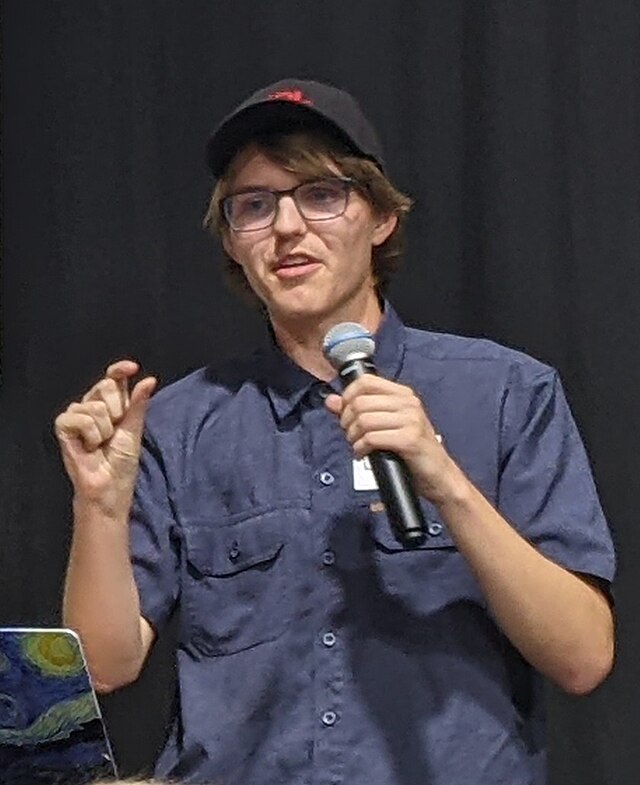
Luke Farritor, source: Wikipedia, By HaeB – Own work, CC BY-SA 4.0, https://commons.wikimedia.org/w/index.php?curid=159474278
Mom and Dad must have been proud. A boy from a fine family of intellectuals. Just like Kosta Kecmanović. Nothing in Farritor's biography is alarming except the fact that he was home-schooled until the age of 15, which indicates a certain arrogance, a belief that one is too exceptional to attend a formal schooling. But Farritor was not a misunderstood genius, an unloved child, because his parents invested in him. He does not come from a poor, uneducated family. The father is a university professor, the mother a doctor, which at least gives indications that they have some education in ethics. So how could he so cold-bloodedly and blindly execute orders, without questioning, without thinking about the consequences and possibly believing in the idea that USAID is an organization that throws funds down the drain and that those 14 million people do not deserve better chances, if they are already deprived of equal opportunities, equal to the global north-west?
Erasing USAID was one of Farritor's main tasks. He was not a broken, disillusioned man who had been let down by the system, nor was he a victim of the infamous DEI (Diversity, Equity, Inclusion). Farritor has never faced the consequences of his actions, nor will he likely ever. He has not seen the consequences, nor will he feel them firsthand, in the safety of the society he creates, as a perfect representative of the in situ modern tech-versions of the anti-heroes from Lord of the Flies.
Techno brothers changing the world. The resurrection of the new right into the ultra-new tech right
He is not the only one, he is just one of the youngest. We have already witnessed the complete lack of ethical frameworks among the first and second generation techbros (I will call them techbro grandpas and papas): Peter Thiel, Alex Karp, Elon Musk, Jeff Bezos, Mark Zukerberg, even Bill Gates and Steve Jobs, especially the latter. Opportunists without moral scruples with hitherto unimaginable power. Zukerberg had the Chan foundation with his wife. The moment the new regime came, this foundation stopped a number of its support programs and grants – those related to DEI and social issues. The only reason why they had them is because the system forced them, so that they would look better in front of that system, in society and have some tax benefits.
Also worth mentioning here is the apostle of the Dark Enlightenment, computer scientist, blogger, (pseudo)philosopher and writer Curtis Yarvin (also known under the pseudonym “Mencius Moldbug”) who advocates replacing democratic institutions with an authoritarian or monarchical system. He believes that American democracy is trapped and proposes the formation of a “startup-style” leader with absolute powers. His ideas have influenced what is now called the New Right or tech-conservative circles, and have been supported by prominent GOP political figures such as JD Vance and Blake Masters. Yarvin is the main thinker behind the Dark Enlightenment movement, an ideological current that seeks to radically reorganize political structures through a technocratic or monarchical vision and often criticizes liberal democracy. And he is appreciated by another right-wing philosopher, Putin’s Alexander Dugin.
By the way, just a small digression – the apostle of neoliberal enlightenment, Steven Pinker, is as silent as a watered-down bird to all that is happening in the world, as is Francis Fukuyama.
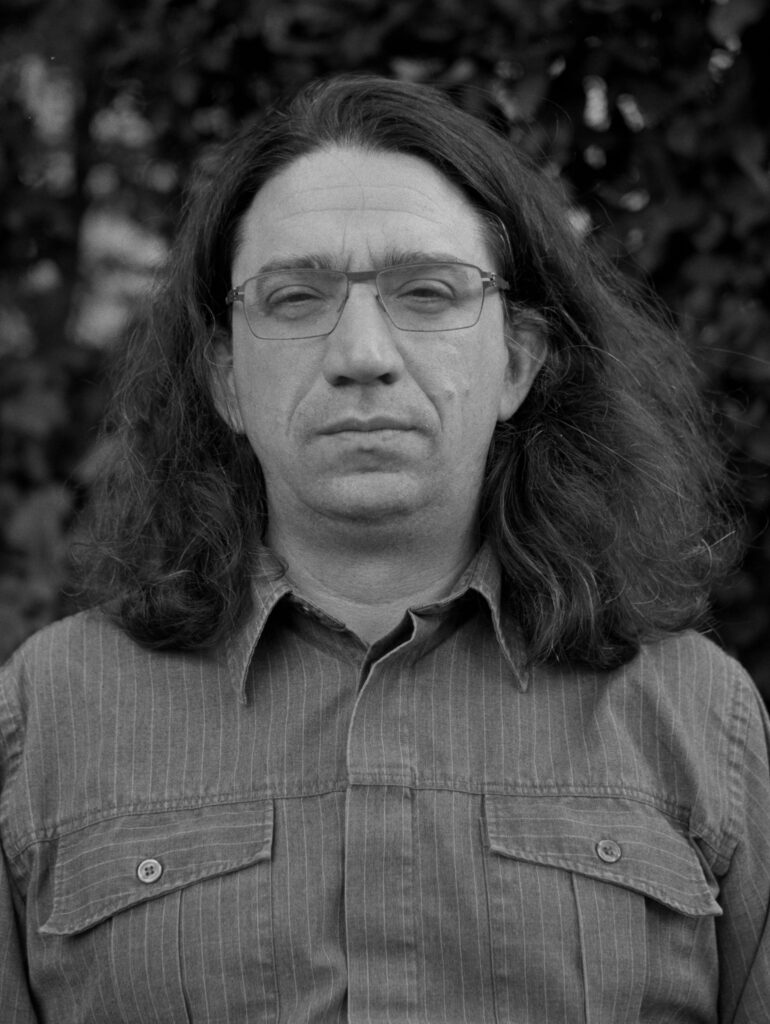
Curtis Yarvin, source: Wikipedia
Yarvin's philosophy and manifestos seem to be a mutant between GREECE-Nouvelle Droitte (New Right – a movement created in the 60s of the last century) by Alain de Benoist, raw capitalism, technoautocracy and the Matrix. By the way, when you ask GenZ, they know what RedPill is, but they don't know what Matrix is.
American Psycho and Lord of the Flies. The disappearance of humanistic values and education as superfluous in late capitalism (they waste money and time, not produce capital)
We see a dehumanization of time and the world at work. These are people without a sense of compassion for their fellow man without sincere philanthropic intentions. Their philanthropy is contained in the Aynrand principle of oxymoronic egoistic altruism (me first, if it's good for me, it will be good for those around me, and this mantra has been repeated in the yuppie world of middle and high management for decades – this is just a new face of the American psycho). It is the morality of self-interest.
And at the same time, neither in our country, nor apparently globally, in the curricula for technical and information, natural-mathematical, programming and AI (STEM) studies, there are no courses from the humanities, especially ethics. There is constant talk about that famous STEAM (science, tech, engineering, arts, math – science, technology, engineering, humanities and arts and mathematics), but in the end it comes down to bare IT.
At the same time, humanities studies sometimes have subjects related to information sciences and often deal with the relationship between science, technology and society.
Future engineers, programmers, people who work on the development of artificial technology and digital transformation should also have humanities subjects during their studies. Moreover, they should have a mandatory lecture once a year in their companies and institutions on the ethics of technology and the impact of technology on society and democracy as part of professional training, a reality-check in, just like there are courses for employees on cyber security. He would need a technical overhaul of values and ethics so he doesn't go astray like young Farritor, who didn't lose his compass, but never had the opportunity to acquire one.
Searching on the Internet, I did not find a single paper/text that calls for the need for education in the field of ethics for these professions. This does not mean that such texts, articles and scientific works do not exist. Nor can I check if there is any subject related to ethics, sociology of technology in the curriculum for these studies. In the course of studying biology, we had the subject Philosophy of Science, which intersected the history of science, scientific methods, methodology, and partly the relationship between science and society. The subject of bioethics itself is too narrow and does not cover the domain of technology, and clerical circles often seize the monopoly over this field.
Elementary and secondary schools as drumbeats of politics
Here, the role of primary and secondary education should also be considered. Humanistic values and ethics are being expelled from these levels of education, and in fact the only morality that young people in our region have the opportunity to hear is that of religious education, of the Abrahamic religions. It is as if this is the only existing ethics, and at the same time this morality is very limited. Empathy and ethical frameworks are adopted early. They are partly (although not in everyone) innate, but even such need to be developed coherently and supported in discussion and examples. Ethics exists as an elective subject for those who do not want to take religious education (and there are few of them).
You know what else provides a moral framework in this formative age? Literature. Good reading. Which is also excluded, censored, and reduced to writers who are politically suitable to be on reading lists and in textbooks. “Literature is not there to show us what the world is like, but what it can be like“, Dževad Karahasan told us at the studio.
The book Lord of the Flies just mentioned is one of the works that discusses morality, freedom, consequences, and evil. We need ethics, humanities, and literature to constantly remind us what it is like to be human.
Ecce homo.
Would inserting this subject into the already overcrowded programming and artificial intelligence courses have an effect? I can't claim. But exposure to these questions, theories, and views might influence some. And that's valuable. To give the framework, ideal and taboo of action in that branch. The same goes for the proposed mandatory courses – they would increase the employer's expenses, which is hardly something anyone would accept voluntarily. Capitalism and ethics do not go in the same sentence.
But if such a thing were set as a legal sine qua non for the registration and operation of the company, institution and job security, then it would be achieved that the employees would be exposed to this kind of thinking (at least against their will). There are a number of other courses and certificates that employers or legal frameworks require from employees and companies/institutions – from driver's licenses and language certificates to gender equality. Donors, such as international institutions, such as the EU, are also looking for the same for applying for projects – if you want money and a project, you must meet these conditions.
Journalists, experts in communications, management, marketing, especially digital marketing, as well as economists (economics has long been isolated from other sciences), and PR experts should also study ethics during their studies.
There is no idea yet for something like this, let alone a framework for such courses to be an integral part of requirements, such as HACCP standards. But perhaps the climate and social circumstances will be created in which this will be inevitable.
Maybe someone is laughing at what I'm saying. Ah, silly me, an idealist who demands that we have internal moral connections and that we all think about how technology and artificial intelligence and our actions affect others and accept responsibility. After all, no one thinks like that at every moment and in every situation, just as we don't all take responsibility for our actions all the time.
But when it comes to the 14 million people at the beginning of this story, we should.
Note: the cover illustration was created using artificial intelligence tools, while the text is 100% human.