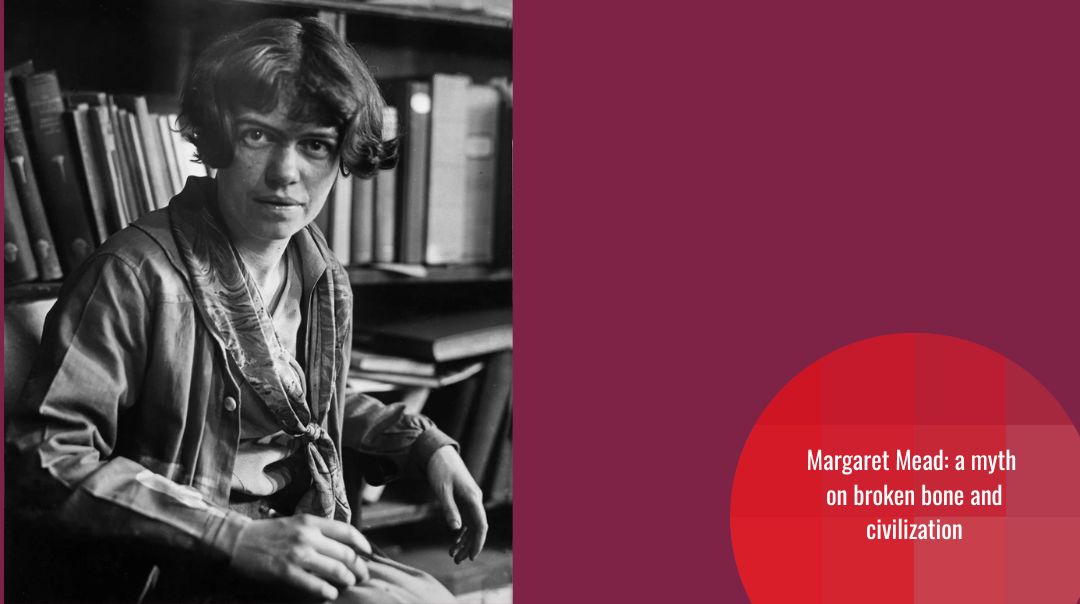
Margaret Mead was an American anthropologist best known for her research on the indigenous peoples of Oceania, including cooperation, competition, and communication among them, along with oceanographic ethnology and comparative child psychology. She started her research in the South Pacific when she was only 23 years old, as a doctoral student. This resulted in her best-selling book Growing Up in Samoa (1928). Throughout her life she traveled to other countries exploring different cultures, including the Arapesh, Mudugumor and Tchambuli in New Guinea. The topics of her public lectures were broad, covering topics from atomic politics to feminism. She was born on December 16, 1901 and died on November 15, 1978.
However, what I want to talk about here is an anecdote about Mead that, for no particular reason, except that it sounds cute and heartbreaking, has been circulating on the Internet for years and escalated during the pandemic, when many found in her inspiration and that necessary glimmer of optimism. The story is good, actually delightfully good, and we fall for stories. You know the one – I'm telling you a story where cattle roar. Storytelling is an interesting way to teach people, but what if the storytelling is based on inaccurate or unverifiable anecdotes, and it sounds good and is so memorable that it just sticks in the brain? Storytelling is seductive and can be a means of manipulation and misinformation. Because we react better to stories that arouse emotion, than to facts.
So what is it about? A brokne bone and myth is born
The anecdote goes like this: Mead considered a curious student's question: What, in her opinion, marks the beginning of civilization in ancient societies? The story, though touching, is shrouded in mystery and has taken on a life of its own online.
According to this nice story, Mead responded unexpectedly. She declared that the first sign of a civilized society is not large cities or complex divisions of labor, as we might assume, but a healed fractured femur – the bone that connects the hip to the knee.
In the wild, Mead supposedly explained, animals with broken limbs faced a grim fate—they became prey before their fractures could heal. The healed human femur, therefore, symbolized something profound: the act of one person caring for another, providing help when vulnerability threatens survival. Mead’s touching conclusion resonated: “Helping someone through hardship—that’s where civilization begins.” Sounds wonderful, doesn’t it? Our hearts softened and we were so happy—that’s what makes us humans civilization!
But as with any intriguing story, skepticism has emerged. When investigating the origins of the story, there is no hard evidence that Mead uttered these words. The earliest known reference dates from a 1980 book by surgeon Paul Brand, who recalls Mead giving a lecture about her studies of primitive cultures. However, when asked directly about when culture becomes civilization, Mead's documented opinion emphasized cities, divisions of labor, and the preservation of records.
In the fascinating fabric of human history, broken bones in the archaeological record not only point to compassion, but also to dark aspects, revealing traces of ancient interpersonal violence. A bone could, of course, have broken naturally, but also as a result of violence.
Furthermore, the very idea of ”civilization” in this anecdote raises eyebrows among contemporary anthropologists, who study and challenge such simplistic definitions.
Danger of nice stories
Today, there is a pressure to tell everything as a story – however, journalism is not just telling stories, journalism should first of all be research in which facts are found and these facts are presented. Today's flirtation with an audience that wants to tell stories is unfounded and not every journalistic text can be a story teller.
So, the story of the healed femur remains – a captivating narrative that invites us to think about the essence of civilization, goodness and the threads that connect us through time. But as with many stories, the truth can remain elusive, leaving us to appreciate—and be skeptical of—the enduring power of a good story. There is no clear evidence that Mead said this, so it would be good if we don't spread this story further on the Internet, because by doing so we are actually participating in the spread of misinformation.
Sources:
Did Margaret Mead Think a Healed Femur Was the Earliest Sign of Civilization?
On Margaret Mead and healed thigh bones: Not all compelling stories are true