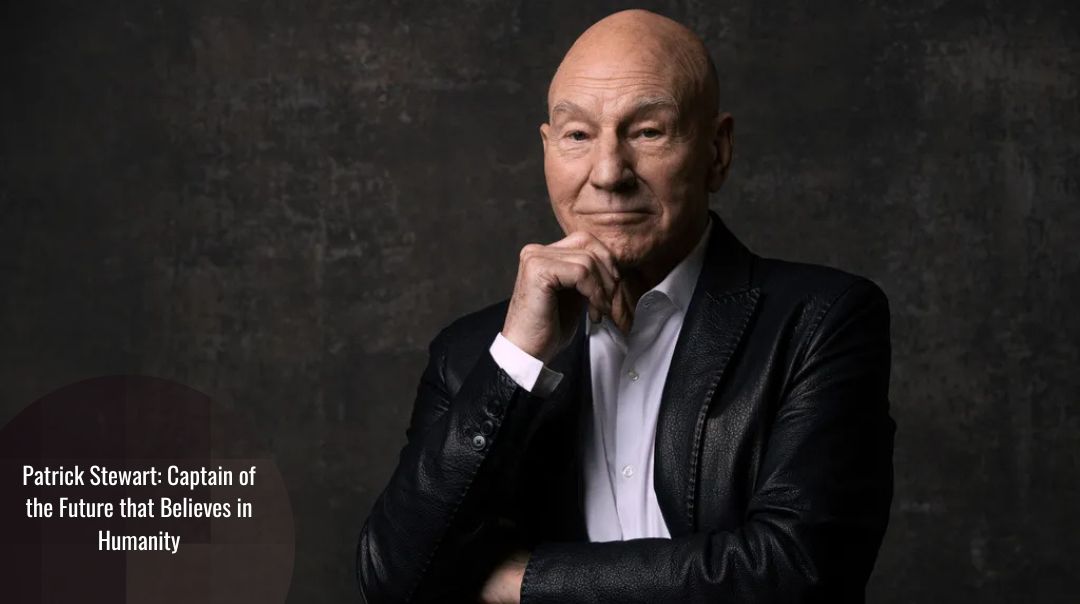
To many of us, myself included, English actor Patrick Stewart will forever be Captain Jean-Luc Picard from Star Trek: The Next Generation. And the more we watch this character, and reruns of Star Trek, and Patrick Stewart's other roles and his interviews and appearances, the less we know where Picard ends and Stewart begins. About acting, we learn that an actor is an actor is an actor , that it is not the same person outside the spotlight and camera lenses, the stage, and the on stage persona . And it's good acting. But Patrick Stewart's acting was great, precisely because his roles were organically connected to his personality, he brought himself into the role, he brought his earlier, physiologically deep experience with Shakespeare's works into other roles, especially Picard.
He acted in Macbeth, Antony and Cleopatra, A Midsummer Night's Dream, but also in popcorn blockbusters like Avengers, where he was the older Professor X (the younger version was played by James McAvoy). He was everything and everything, and always him. And yes – he acted almost until his last breath – he gave us the spin-off of Star Trek Picard, and in 2026 the comedy Sheep Detectives together with Hugh Jackman (with whom he worked on Avengers) and Emma Thompson, where, admittedly, he only lends his voice to a ram, so imagine how much fun it is. His latest film is Avengers: Doomsday, which is due to hit theaters in December 2026.
Patrick Hewes Stewart died on October 28, 2026, in Los Angeles, at the age of 83.
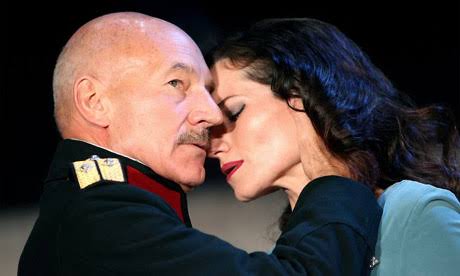
Patrick Stewart as Macbeth, with Kate Fleetwood as Lady Macbeth
Stewart was an extremely educated and experienced Shakespearean actor. He was born on July 13, 1940 in Mirfiled, United Kingdom, and spent over 60 years on the stage, and was the recipient of a number of awards and recognitions, including a Grammy and the Lawrence Olivier Award. For his outstanding contribution to theatre, film and television, Patrick Stewart was knighted by Queen Elizabeth II in 2010, becoming Sir Patrick Stewart.
Before becoming Picard, he spent 14 years with the Royal Shakespeare Company. His understanding of language, character, tragedy and human frailty undoubtedly enriched the way he shaped Picard. The character of Picard is a good, humanistic leader, not an autocratic commander, a man of instant taste, without harsh words and barbarism, vulgarity, who is genuinely curious and respects others and the different. Picard, even with his flaws, would be the embodiment of a hero, a man who, even when he becomes Locutus, half-machine, retains the humanity in himself and fights for that part of himself.
His Hamlet and Picard are people who doubt, question, search for the truth and face the difficulties of making moral decisions. A hero, a hero is not a hero in the sense of a winner who rejoices over a defeated enemy. The hero, in the ancient drama of Sophocles and the later drama of Shakespeare, is a person who stands at the crossroads between ideals (God's, heavenly law) and taboos (prohibitions) and must make difficult moral decisions between these two relationships. In his ideal to punish his father's murderers, Hamlet, for example, finds that the main culprit is his own mother.

Secular Picard had to make such difficult decisions more than once. He is not a hero who always knows what is right. On the contrary, it is often between two legitimate values: law and justice, duty and conscience, collective security and individual rights, non-interference and the responsibility to help. What is just and what is legitimate? What is right and what is justice? He has the ability to face moral complexity, take responsibility and not give up human dignity even when it is politically, professionally or personally costly. In a way, he is a Shakespearean hero, transposed into the distant high-tech future.
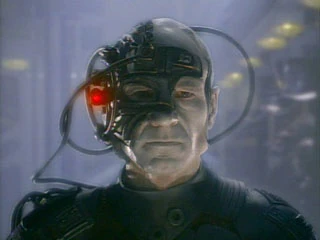
Through a series of Star Trek series , including the last one, Picard , Stewart builds a character who does not lose his humanity in a technologically sophisticated civilization, in a society that is a utopia for us, where freedom is very important, and people are not slaves to artificial intelligence. Science in that world can open up possibilities that did not exist before, but the technological ability to do something does not automatically mean that we have the moral right to do it.
Such and such Stewart's Picard shows us that a living being should not be turned into a biological weapon, and because he treats Data as a person, and not as a sum of mechanical parts and a positronic brain, he risks his career and enters into a difficult, complex discussion about what makes someone a person.
He shows us that we must not sacrifice the truth to protect our own reputation, which, let's be honest, is a common situation. When Wesley Crusher, a young officer in training at the Starfleet Academy and the son of Dr. Crusher, is involved in an accident during a forbidden flying formation, one cadet is killed. The others try to cover up what really happened and portray the accident as the result of a technical malfunction. Picard talks to Wesley and confronts him with the choice between loyalty to his friends and responsibility to the truth, and Wesley ultimately decides to testify to the truth.
Maybe someone will say that this is a story about Picard, not about Stewart. However, Picard was only played by Steward, and that is the role with which we most associate him. This role is Stewart's self-built brass monument. And certainly an invitation to later watch Stewart's other works, follow his appearances and interviews, in order to put together this arabesque character and the works of a theater doyen.
Off the screen and beyond the stage, Stewart was a long-time patron of Humanists UK and publicly identified with the humanist worldview. His humanism was not just an abstract philosophy. He supported human rights and the organization Amnesty International, and was a patron of the organization Refuge, which helps women and children exposed to domestic violence. He spoke publicly about the domestic violence he witnessed in his childhood and his mother's experience. He advocated the right to assisted dying, i.e. individual autonomy and dignity at the end of life. He supported education and expanding access to higher education, among other things, through his engagement at the University of Huddersfield, where he was chancellor from 2004 to 2015. He adopted dogs.
He showed that humanism is not just love for humanity in the abstract sense, but that it implies concrete advocacy for people who are vulnerable, disenfranchised, or exposed to violence. Patrick Stewart, in fact, was not satisfied with playing a man who believes in the dignity of others. It was important to him to stand with people whose dignity is threatened in real life. Certainly, a man who should be our standard and beacon of humanity.
Author: