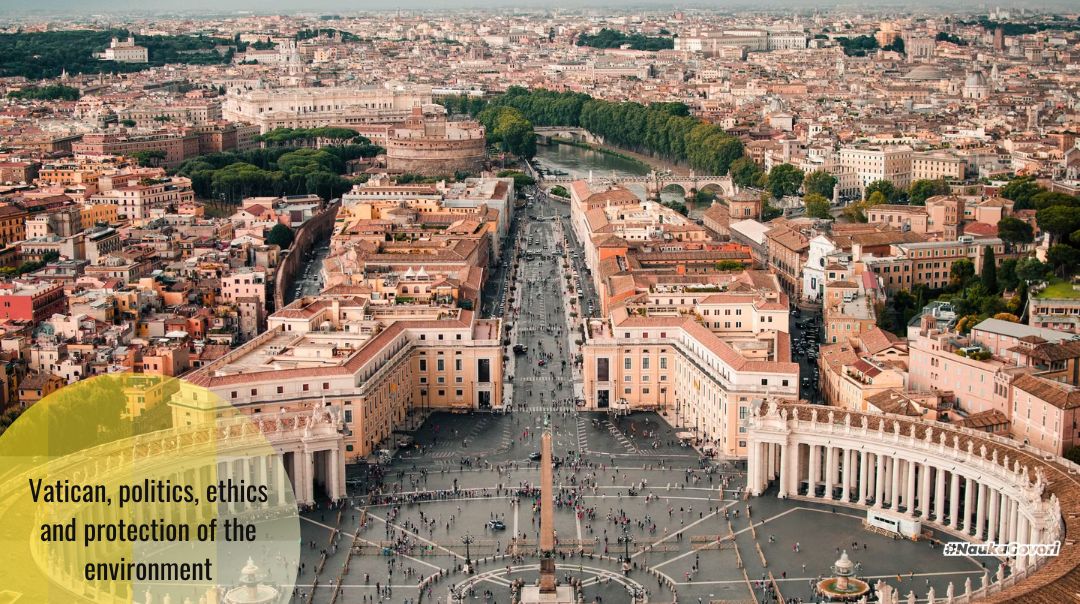
The Vatican's International Theological Commission proposes a new way of theological reflection on the ecological crisis: the serious destruction of nature should not be viewed only as an ecological or social problem, but also as a sin against creation and the Creator.
In the document Prendersi cura della nostra Casa comune: risposta responsabile e fraterna al Dio trinitario, authorized by Pope Leo XIV and published in early September, the Commission links man's responsibility towards nature with his relationship with God, other people and future generations. The document was developed from 2022 to 2025, and was approved by the Commission in July 2026.
The authors start from the traditional Christian understanding that man is entrusted with the care of creation. Therefore, as they state, “care for our common home” is not only a question of ecology, but also of relationship with God.
Of particular interest is the section entitled “A Bold Diagnosis: Sin Against Creation and the Creator.” The Commission proposes that ecological sin be understood analogously to the concept of social sin. “ A common home that is fit for life is the fundamental expression of the common good ,” the document states.
“We propose to define ecological sin as an act or omission against God, against one's neighbor, the community, and the environment. It is a sin against future generations and is manifested in acts and habits of pollution and destruction of ecological harmony, violation of the principle of interdependence, and disruption of networks of solidarity among creatures against the virtue of justice ,” the document further states.
Even more directly, the Commission writes that man has the task of preserving and improving the common home and concludes: “Not doing so, by actions or omissions, means disobedience to God.” The consequences are not only damage to nature. Such behavior, the authors state, harms other people as well, “especially the poor and future generations”.
The document does not only talk about individual behavior. It also explicitly mentions political, economic and trade union leaders who, when they have the opportunity to act, do not do enough to improve society and protect the common good.
This document also draws on Pope Francis’ encyclical Laudato si’ as well as his books Laudate Deum and Querida Amazonia , which is the post-synodal apostolic exhortation of Pope Francis from 2020, created after the Synod of Bishops on the Amazon and dedicated to the future of the region, its inhabitants and the protection of the Amazon rainforest. Querida Amazonia speaks of four “great dreams” for the Amazon – social, cultural, ecological and ecclesial – and in particular connects the protection of nature with the rights of indigenous peoples and social justice. Laudate Deum (“Praise God”) is the apostolic exhortation of Pope Francis from 2023, a kind of continuation of the encyclical Laudato si’ , dedicated to the climate crisis. In it, Pope Francis sharply warns of climate change, criticizes the insufficient action of political and economic actors and calls for international cooperation and the reduction of greenhouse gas emissions.
Pope Francis constantly referred to the results of scientific studies in order to make an urgent appeal for a complete ecological conversion based on them, formulated in different ways, and this is exactly what Pope Leo XIV continues to do.
Caring for our Common Home highlights issues of biodiversity threats, which it says is not a luxury, but on which food chains depend. It highlights the problems of air pollution, the transmission of zoonoses, pollution, especially microplastics, fertilizers and heavy metals, and calls for multilateralism in addressing these problems.